


BKB Chairman addressing a seminar
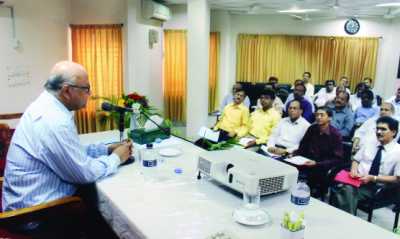 Bangladesh Krishi Bank Chairman Khondkar Ibrahim Khaled addressing a seminar on 'Good Governance and Ethics in Banking' organised by Sonali Bank Limited in the city recently. Sonali Bank high officials also attended the seminar.
The Financial Express/Bangladesh/ 12th June 2012
Coop societies to pay 42.5pc tax for banking business
Banking business of cooperative societies brought under the tax net in the proposed budget aims at maintaining discipline in operations of the entities.
Cooperative societies will have to pay tax at 42.5 per cent rates from July 1 next if they run any banking business along with their cooperative activities.
"We have noticed that majority of the cooperative societies are doing banking business, like scheduled banks. But they are enjoying tax exemption facility as cooperatives while banks are paying corporate tax at highest rate," said a senior revenue board official.
Recently, banking businesses by Destiny cooperative societies came under close scrutiny of the government law enforcing agencies including National Board of Revenue (NBR), Anti-Corruption Commission (ACC) and Bangladesh Bank.
Bangladesh Bank (BB) in an investigation has found Tk 7.06 billion embezzled and Tk 700 million siphoned off by Destiny Multipurpose Cooperative Society Limited.
In the Finance Bill-2012, the revenue board has withdrawn the tax-exemption facilities for banking activities of cooperative societies. The cooperatives are enjoying tax exemption facility on their banking activities under sub-section (1) of section 47 of Income tax ordinance, 1984.
The government amended the section by excluding the statement 'including a co-operative society carrying on the business of banking' in the Finance Bill-2012, from the list of tax exemption.
The official said illegal banking business in the name of cooperative activities is now under strict surveillance of the government. Tax authority amended the rule with an aim to check these irregularities.
Many cooperatives are operating in the country using the word 'bank' after their names to attract public confidence in them.
The cooperatives which collect deposits from persons other than their members will have to pay 42.5 per cent tax from the next fiscal, the official said.
People who are involved in cooperatives often start banking taking advantage of the existing weakness of law.
Earlier, a number of cooperatives -- Unipay2, ITCL, Jubok -- pocketed millions of taka of general people through illegal banking in the name of Multilevel Marketing business as cooperatives.
Former adviser and economist Hossain Zilliur Rahman said the move might have taken to bring the cooperatives under a discipline rather than revenue generation.
It can be called a 'protective step' to thwart financial irregularities of cooperative societies, he added.
"The cooperatives have a glorious past, but it is widely abused due to loopholes in law and bureaucratic complexities," he added.
There is no statistics on how many cooperatives are running their activities in the country.
Dr. Rahman, who is also founder of Power and Participation Research Centre (PPRC), said there is no study on this sector to find out the number of cooperatives.
The Financial Express/Bangladesh/ 12th June 2012
Muhith still hopeful of WB's Padma Bridge funding US will discuss the issue with global lender: Mozena
Finance Minister AMA Muhith on Monday said he was still optimistic about getting the $1.2 billion committed fund from the World Bank (WB) to construct the Padma multi-purpose bridge.
"I am still hopeful. I have never lost hope," Muhith told reporters responding to a query whether any hope is still left in getting the promised fund from the WB.
The finance minister was talking to reporters at his secretariat office after a meeting with the US Ambassador Dan W Mozena. Muhith said again that the government will be able to make a final decision on Padma Bridge by July.
"We are still negotiating with the WB," Muhith said.
Besides, a number of countries including the US, India, Japan and the United Kingdom also talked to the WB to settle the problems concerning the Padma Bridge Project financing, he added.
The finance minister said he would soon respond to a WB's letter on the entire issue to remove misunderstanding and help get the fund released.
Country's biggest infrastructural project ran into trouble when the WB suspended disbursement of its $1.2-billion loan to the government for the $2.9-billion project on graft allegations in bidding process in October last year.
Apart from the WB, Asian Development Bank (ADB) had pledged $610 million, Japan International Cooperation Agency (JICA) $400 million and Islamic Development Bank (IDB) $140 million as loan for the $2.9-billion bridge project.
After the WB suspended the release of its committed fund for the project, the government signed a memorandum of understanding (MoU) with Malaysia on February 21 last to construct the 6.15-kilometre-long bridge, following a formal proposal that Dhaka had received from Kuala Lumpur.
The US Ambassador said they talked about their shared aspirations about Padma Bridge and expressed the hope that a way could be found in enabling the lending organisations including the WB to work together to construct the most important bridge. Bangladesh cannot be a 'Bengal Tiger' if 25 per cent of its population living in its 19 southwestern districts remain cut off from the development process, he said.
"We have taken up the case with due importance and will continue to discuss it with the management of the World Bank," the US Ambassador said.
The Ambassador expressed the hope that the Trade and Investment Cooperation Framework Agreement (TICFA) would be signed very soon.
"I discussed the issue with the foreign secretary and shared information I have from Washington," he said. "The issue is with the government. I hope for a timely response."
Bangladesh and the US are engaged in TICFA negotiations for the last two years and the only unresolved issue remains to be the one concerning labour standards.
Mozena said the US buyers are much concerned about the reputation as the image of Bangladesh was being tarnished over the issue of labour rights and safety in the garment factories of Bangladesh.
The US envoy expressed the fear that it would have negative impact on the Bangladesh export to the US market if the killer of Aminul Islam, a labour leader, is not arrested and brought to justice.
The Financial Express/Bangladesh/ 12th June 2012
‘Green Banking way to sustainable economic growth’
Speakers at a workshop observed that green banking can be an avenue to reduce pollution and save the environment aiding sustainable economic growth.
They said banking sector is a major source of financing for commercial projects which is one of the indicators of economic growth recently.
These observations came at a workshop on green banking organised by Bank Asia Ltd in the city marking the World Environment Day, said a press release. Md Mehmood Husain, president and managing director of the Bank, inaugurated the workshop which was conducted by Dr Shah Md Ahsan Habib, professor and director (Training) of Bangladesh Institute of Bank Management (BIBM).
Launching the event, Mehmud Husain highlighted how the developed countries are embracing initiatives that are conducive to the environment in order to ensure well-being of the future generation. He said Banks play a critical role in economic development and they are well equipped to undertake Green Banking activities. He reiterated that Banks should finance the sectors that would ensure sustainable and eco-friendly environment.
Senior officials of different branches of the Bank located in Dhaka city and Chittagong Zonal Office participated in the workshop. At the workshop, Dr Ahsan Habib provided a cognitive understanding of the concept of Green Banking and highlighted the role of NGOs, banks and financial institutions (FIs) in the evolution of Green Banking policies and practices. He underscored the importance of taking such initiatives by the country’s banks and FIs.
Green Banking is a multi-stakeholders’ endeavour where banks have to work closely with government, NGOs, IFIs/IGOs, central bank, consumers and business communities to reach the goal. Green Initiatives by banks include internal environment management, environmental financing/product ecology, environmental disclosure and reporting, formulating and adopting principles and promoting other stakeholders.
The speakers observed that regulatory enforcement by the government, pressure from the civil society and consumers, voluntary supports and responses by the business entities are preconditions to create a congenial atmosphere. A framework of incentives for responsible banks and disincentives for pollutants is an essential element for the development of green banking.
Meanwhile, Bangladesh Bank issued policy guidelines for developing Green Banking practices and Environmental Risk Management and circulars to handle climate change.
Now the central bank needs to play a proactive role in guiding green banking initiatives, the speakers said.
They said the country’s banks may work collectively and move forward by undertaking voluntary initiatives.
Financing environment-friendly projects will also help the financial institutions to avert legal, reputation, security and credit risks, they pointed out.
At present a growing number of banks have been assessing environmental risk while selecting projects for financing.
In the concluding session of the workshop, Md Touhidul Alam Khan, SEVP, Head of Corporate Assets and Client Origination and Team Leader of Green Banking Unit of Bank Asia, highlighted the activities undertaken by the bank and briefed on future course of actions. He informed that Bank Asia has taken a number of initiatives regarding the implementation of environmental policies, strategies and programmes in the area of Green Banking activities.
The Bank has conducted activities related to in-house environment management, financed a number of environment-friendly projects, created climate risk fund, utilised online banking facility to serve the clients through alternative delivery channels and has also arranged workshops/ training for capacity building and awareness.
The Daily Independent/Bangladesh/ 12th June 2012
Trust Bank okays 10pc cash, 10pc bonus share
 Bangladesh Army Chief and TBL Chairman General Mohammad Abdul Mubeen, NDC, PSC seen at the 13th AGM of the Bank in Dhaka Monday.
Trust Bank Limited (TBL) has approved 10 percent cash dividend and 10 percent bonus share for its shareholders for the year 2011.
The approval came at the Bank’s 13th annual general meeting (AGM) held at Golf Garden, Army Gold Club, Dhaka Cantonment Wednesday, said a press release Monday.
Total financial growth, audit report and future plan of the Bank were presented at the meeting in presence of a large number of shareholders.
Bangladesh Army Chief and TBL Chairman General Mohammad Abdul Mubeen, NDC, PSC was present at the meeting.
Bangladesh Army’s Adjutant General and TBL vice chairman Major General Ashraf Abdullah Yusuf, managing director and chief executive officer Shah Alam were also present.
The Daily Sun/Bangladesh/ 12th June 2012