


BB pledges to reach the unbanked The central bank to adopt a 'people-centric' model
The Bangladesh Bank will adopt a “people-centric” growth and empowerment model to provide economically deprived people with financial services to ensure overall economic development, Governor Atiur Rahman said yesterday.
The central bank will do the job under its Bangladesh Bank financial inclusion initiatives with the thematic outline “Including Excluded People”.
The initiatives were presented at the inaugural session of the national consultations in preparation for the international conference on people's empowerment model, organised by the foreign ministry, in the capital.
Rahman defined the financially excluded people as those who are dwelling in remote, sparsely populated locations and deprived of financial and social services and the financially excluded institutions are those micro and small scale farm and non-farm organisations which are excluded from financial services.
As an example of an initiative, for the first time, savings accounts of more than 9.6 million farmers have been opened -- each with a deposit of Tk 10 only -- and are being used for government transfers such as diesel subsidy.
Until June 10, Bangladesh Bank has provided Tk 490 crore to BRAC's refinancing scheme with which the development organisation provided loans to 4.15 lakh sharecroppers in 250 upazilas of 48 districts.
Asked how effectively the initiative is being implemented, the BB chief told The Daily Star: “I personally call farmers' mobiles randomly to find out whether they received the money.”
Under the BB's directive, student loans are also given out to poor students living on the outskirts of the city, which Rahman described as a “high-return investment”.
When the people living on the outskirts are brought under the initiative, every worker working in the capital will be able to send money with their mobile phones to their remote village in Kurigram also, he said.
The Daily Star/Bangladesh/ 14th June 2012
WB lists reasons for economic shocks It forecasts Bangladesh's GDP growth at 6.4pc next fiscal year
The World Bank has identified a number of reasons that dealt a blow to Bangladesh economy.
The reasons include political turmoil and periodic strikes, widespread electricity shortages, near double-digit inflation, fiscal deficit and deteriorating external balances.
Bangladesh's economic growth may be 6.4 percent in the next fiscal year, the lender said in its Global Economic Prospects June 2012 released worldwide on Tuesday.
In the current fiscal year, the government has estimated the GDP (gross domestic product) growth rate at 6.3 percent, down from 6.7 percent last year.
The WB report also said exports have been affected by weaker demands from key European trade partners, while infrastructure constraints, especially electricity shortages, have become acute, partly due to higher crude oil prices.
It also said agriculture output growth is also estimated to have slowed to less than 2 percent in the current fiscal year from the previous fiscal year's 5.1 percent. But a good crop harvest is expected for the current agriculture season due to favourable weather, the WB said.
The report said monetary tightening and easing of food inflation are likely to continue to put a downward pressure on the overall inflation.
Non-food inflation, however, remains persistently high partly due to the still-high costs of imported inputs and pressure from a huge government spending.
The report also said South Asian countries, including Bangladesh, may require a significant upward adjustment to the international fuel prices to ease the pressure on subsidy.
The WB said, even after recent price hikes in Bangladesh and Sri Lanka, energy products are still subsidised to some extent.
Moreover, election schedules in the coming two years in several south Asian countries and an intention to protect consumers from the inflationary impact of higher fuel prices could make it difficult for the governments to reduce subsidies and raise the oil prices, it said.
The Daily Star/Bangladesh/ 14th June 2012
Merchant banks are NBFIs: BB
The central bank has defined merchant banks as non-banking financial institutions (NBFIs), creating confusion over the status of the merchant banks, which are involved in share market activities, not in the financial sector.
Bangladesh Bank in a letter to the Securities and Exchange Commission (SEC) on June 6 said the merchant banks are considered as NBFIs as per Section 2(b) of Financial Institution Act, 1993.
A clause of the act included merchant banks, among others, in the category of financial institution.
The SEC on June 10 forwarded the central bank's letter to Bangladesh Merchant Bankers Association (BMBA), a platform of the merchant banks.
Earlier, the stockmarket regulator on May 20 sought the banking regulator's opinion about the status of merchant banks.
The finance minister in his budget speech also treated the merchant banks as NBFIs, and proposed to reduce their income tax from 42.5 percent to 37.5 percent.
Later, the BMBA at a press briefing said the government's offer to reduce the income tax for merchant banks was met with a wave of confusion, as they were already paying the lower rate of 37.5 percent.
Merchant banks provide a myriad of financial services, ranging from underwriting shares to lending to stock investors amongst other activities. Due to their multi-faceted roles as financial institutions they are not classified in the same bracket as 'banks and non-bank financial institutions'.
The National Board of Revenue (NBR) wrote a letter to merchant banks putting them in the same classification as the rest, an idea which was met with vehement objections from merchant bankers. The plan did not come into effect.
“The merchant banks have always paid 37.5 percent tax while it is 42.5 percent for banks and non-bank financial institutions,” Mohammad A Hafiz, president of BMBA, told the press briefing.
“We are also not allowed to take deposits, disburse loans and perform other financial activities what NBFIs can,” Hafiz said.
Merchant banks, as opposed to 'banks and non-bank financial institutions', are not licensed by the central bank but by the SEC, he said.
There are 43 full-fledged merchant banks in the country now.
The Daily Star/Bangladesh/ 14th June 2012
Big Four's new money
 Traders work on the floor of the New York Stock Exchange.
Many more years of money printing from the world's big four central banks now looks destined to add to the $6 trillion already created since 2008 and may transform the relationship between the once fiercely-independent banks and governments.
As rich economies sink deeper into a slough of debt after yet another wave of euro financial and banking stress and US hiring hesitancy, everyone is looking back to the US Federal Reserve, European Central Bank, Bank of England and Bank of Japan to stabilise the situation once more.
What's for sure is that quantitative easing, whereby the "Big Four" central banks have for four years effectively created new money by expanding their balance sheets and buying mostly government bonds from their banks, is back on the agenda for all their upcoming policy meetings.
Government credit cards are all but maxed out and commercial banks' persistent instability, existential fears and reluctance to lend means the explosion of newly minted cash has yet to spark the broad money supply growth needed to generate more goods and services.
In other words, electronic money creation to date -- whether directly through bond buying in the United States or Britain or in a more oblique form of cheap long-term lending by the ECB -- is not even replacing what commercial banks are removing by shoring up their own balance sheets and winding down loan books.
Global investors appear convinced more QE is in the pipe.
"It is almost as if investors are saying QE will happen no matter what," said Bank of America Merrill Lynch's Gary Baker.
BoA Merrill's latest monthly survey of 260 fund managers showed nearly three in four expect the ECB to proceed with another liquidity operation by October. Almost half expected the Fed to return to the pumps over the same period.
The BoJ has already upped asset purchases yet again this year and Bank of England policy dove Adam Posen said on Monday the BoE should not only buy more government bonds but target small business loans too.
But aside from investor hopes of a market-based call and response, is there any evidence that QE actually helps the underlying problem and what are the risks from all this?
The "counterfactual", to use an economics wonk's term, is the most powerful argument in QE's favour -- what would have happened if they didn't print at all and broad money supply collapsed?
But after four years in which, according to HSBC, the balance sheets of the Big Four have collectively more than tripled to $9 trillion and still not generated self-sustaining recoveries, the question is how long this can keep going on without creating bigger problems for the future.
For a start, there is no quick solution to the problem of mountainous indebtedness.
Recapitalizing banks; stabilising housing and mortgage markets responsible for deteriorating loan quality; further deep integration of euro fiscal links to support the shared currency; and capping government debt piles in the United States, Japan and Britain will -- even for optimists -- take many years.
On top of that the rich economies face gale force headwinds over the next decade from ageing and retiring populations.
In the interim, the job of central banks looks increasingly like a blended mix of monetary policy and sovereign debt management. And that's on top of recently acquired roles as guardians of financial and banking system stability.
The concern is that monetary authorities are increasingly acting as government agents responsible as much for stabilising bond markets and keeping banks clean as for fighting inflation.
The question is not whether central banks can withdraw this money again once broad money growth gains traction -- most think that's mechanically easy -- it's whether they will be able to resist pressure to carry on underwriting government deficits.
A series of papers prepared for a Bank for International Settlements workshop in May certainly saw the problem.
"Whatever view is taken of this, the boundary between monetary policy and government debt management has become increasingly blurred. Policy interactions have changed in ways that are difficult to understand," the BIS overview concluded.
The papers also made clear that this form of monetary policy has plenty of precedents throughout the earlier part of the 20th century during the gold standard. It's only since the 1980s and 1990s that consensus shifted squarely behind the idea of highly independent central banks pursuing narrow price stability and even strict inflation targets.
And given the level of credit chaos that ultimately emanated from the so-called Great Moderation, it's possible that history will see that system as the aberration rather than norm.
HSBC economists Karen Ward and Simon Wells reckon central bank independence is the biggest impact from ever-more QE and fear that, as in Japan, the price will be paid by persistently high if sustainable government deficits that stifle growth.
"The heyday of independent central banking could be drawing to a close," they wrote in a wide-ranging report on QE.
Hedge fund manager Stephen Jen said he thinks the temporary benefits of QE are outweighed by long-term costs such as removing pressure for fiscal reform and market volatility.
"At some point, the benefit-cost balance flips."
Then again, not everyone bemoans the greater responsiveness of central banks to the will of elected governments.
“The source of central bank independence is public support from elected officials that the central bank is pursuing desirable social goals,” BoE's Posen said Monday.
The Daily Star/Bangladesh/ 14th June 2012
JP Morgan's $2b experiment
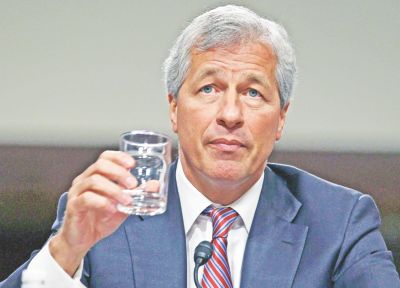 Jamie Dimon, president and CEO of JP Morgan, drinks water as he testifies before a Senate Banking Committee hearing on Capitol Hill yesterday in Washington, DC.
Jpmorgan Chase & Co blames its $2 billion, and maybe much larger, trading loss on mistakes made in hedging the market. Bill Black, a finance criminologist, calls this “hedginess.”
“Hedginess” riffs on “truthiness,” the word the comedian Stephen Colbert invented in 2005. Truthiness means favouring versions of events that one wishes to be true, and acting as if they were true, while ignoring facts to the contrary that are staring you in the face. Fake hedges are to real hedges as “truthiness” is to truth. Hence “hedginess.” JPMorgan's trades got around the Volcker rule, which tries to prevent banks from speculating in financial derivatives, by labelling as “hedges” bets that were clearly not hedges.
As Black puts it, JPMorgan is now defining as a hedge “something that performs in exactly the opposite fashion of a hedge.” A hedge is supposed to reduce risk, but according to Black, the losses came from deals that “dramatically increased risk by placing a second bet in the same direction, which compounded the risk.”
Actually, it isn't quite as simple as Black says. While JPMorgan did not respond to my questions on its strategy, Reuters and others have reported that the trade began as a standard hedge. Subsequently, the reports say, it morphed into speculation as the bank layered bet on top of bet.
Such doubling down is why Black says JPMorgan indulged in hedginess.
Who is Black to pronounce on such things? As a senior regulator at the Federal Savings and Loan Insurance Corp, he, more than anyone else, was responsible for the more than 3,000 felony convictions in the savings-and-loan crisis. Black now talks his walk as a law and economics professor at the University of Missouri-Kansas City.
The S&L crisis of the late 1980s was a mere grenade compared to the weapons of mass wealth destruction that went off on Wall Street four years ago and the others that remain primed and ready to explode. But instead of facing indictments, JPMorgan and others face impunity. “It's clear that JPMorgan has absolutely no fear that this might have consequences,” Black said. “And why should they?”
As Black is quite right to note, there are exactly zero reasons that Wall Street should fear the consequences of its compulsive gambling, be it with the money of shareholders or the deposits of its clients.
Too Big To Fail banks like JPMorgan enjoy an implicit federal guarantee in the event a manageable $2 billion loss becomes an unmanageable $20 billion loss. These banks have also delayed implementation of the Volcker rule, which bars some speculative trades, and other provisions of the Dodd-Frank law as they work to make it more loophole than law. Most disturbing is Wall Street's success in blocking any move to restore Glass-Steagall, which required commercial banks to take deposits and make loans, not speculate like JPMorgan did. With Glass-Steagall restored we would not be talking about bailing out banks that speculate.
Headlines blare that the FBI is investigating the JPMorgan trades for evidence of crimes. But down in the fine print the bureau calls this routine. It's show, not substance, our own Captain Renault rounding up the usual suspects in Casablanca.
Says Black: “There has not been a single investigation by the Justice Department worthy of the word investigation of any of the major entities whose frauds caused the financial crisis.”
Criminal investigations now hardly matter, because most of the frauds took place before 2008. Under the five-year statute of limitations for most federal frauds, governments let the crooks run out the clock. They keep their riches, their reputations, their jobs and, absent real reform and real regulation, plunder on.
Both the George W Bush and Obama administrations have let the crooks escape. The challenger who wants to replace President Obama would be even worse. Mitt Romney wants to repeal Dodd-Frank. Unless some determined and creative prosecutor finds a way to pursue the wrongdoers, there will be no justice, just more gambling with taxpayers on the hook to pay off the markers. Only Eric Schneiderman, the New York state attorney general, offers any hope, but his staff is tiny and the crimes are mighty.
Keep in mind that in 2004 the FBI and the Mortgage Bankers Association in 2004 said there were only two kinds of mortgage fraud, both of them perpetrated by unqualified borrowers who could not repay their loans. The FBI said nothing about banks profiting off huge fees for issuing fraudulent “liar loans,” nor about why banks lacked standards and practices to turn away unqualified borrowers. I'll call that “investigativeness.”
The Too Big To Fail banks' triple play of lobbying, campaign donations and lucrative jobs for family and friends of Washington officials, elected and appointed, blocks real regulation. Budget cuts and rules in fine print have declawed the SEC and the Comptroller while filing the IRS's audit teeth down to nubs. Washington regulators are looking for problems in all the wrong places, when they are looking at all.
That's “regulationiness.” The JPMorgan derivatives debacle reveals how the appearance of banking regulation and reform, rather than actual regulation and reform, threatens the financial health of the entire nation. That's what comes of “hedginess.”
The Daily Star/Bangladesh/ 14th June 2012