


Economists doubt 7.2pc GDP growth next year They point to govt's poor implementation capacity
 From left, Muhammad Abdul Mazid, former chairman of NBR; MA Taslim, a professor of economics at Dhaka University; AB Mirza Azizul Islam, former caretaker government adviser; Zaidi Sattar, chairman of Policy Research Institute (PRI); Nihad Kabir, vice-president of Metropolitan Chamber of Commerce and Industry (MCCI); Anis A Khan, chairman of the tariff & taxation sub-committee of MCCI, and Ahsan H Mansur, executive director of PRI, attend a press meet on the 2012-13 budget, co-organised by the MCCI and PRI at the MCCI office in Dhaka yesterday.
A panel of economists yesterday doubted the chances of the government of achieving 7.2 percent economic growth in the next fiscal year.
The government may fail to reach the goal due to weak export growth amid a sluggish global demand and the presence of energy and infrastructure constraints to boost investment, they said.
They also expressed concern over proper implementation of the next fiscal year's budget due to weak capacity of government agencies.
They spoke at a press meet on the proposed budget for 2012-13, co-organised by Metropolitan Chamber of Commerce and Industry (MCCI) and Policy Research Institute (PRI) at the chamber's office in the capital.
Only two out of the 19 indicators of the economy -- remittance inflows and revenue collection -- raise hopes, said Mirza Azizul Islam, former finance adviser to a caretaker government.
The remaining 17 indicators are clearly moving towards undesirable direction at varying degrees, said Islam.
His remarks came at a time when exports growth is slowing down, while pressure on the balance of payments is rising due to dwindling foreign exchange reserves coupled with soaring subsidy pressure.
At the same time, the government's dependence on bank borrowing has created concerns among the private sector on availability of credit.
Ahsan H Mansur, executive director of the PRI, said the global economy is experiencing a 'second round of shocks' and Bangladesh has begun to face the impact of it like other countries.
"Slowdown is very much real. It is on our doorstep," he said, adding that the global recession has certainly affected Bangladesh through the export sector and general investors' sentiment, which translated into slower manufacturing and services activities and lower investment.
But a relatively strong domestic demand due to increased remittance inflows helped sustain domestic economic activities and revenue performances, he said.
He said a strong growth in the industrial sector, generally supported by garments, is needed to achieve the government's target of 7.2 percent economic growth.
"This will be extremely challenging in FY2013 due to the weak export demand in the EU and the US," he said.
Mansur hoped the government may achieve the target for 7.5 percent inflation mainly because of the falling commodity prices on the international market and a tight monetary policy of the Bangladesh Bank.
On the budget, Mansur said implementation challenges are enormous for the government due to its capacity dearth.
The 7.2 percent growth target has been set in line with the sixth five-year plan where it was assumed that energy shortage would ease and investment would rise while global economy would remain stable, said Zaidi Sattar, chairman of the PRI.
But gas and power shortages still remain as significant impediments to rapid growth, he said. Poor investment climate stymied new investments, he added.
"If the investment rate is not rising, because domestic and foreign investments are both constrained, it is time to accept reality and reconcile with a lower GDP growth until the logjam of 24-25 percent investment rate is broken," he said.
Prof MA Taslim of the economics department at Dhaka University said the proposed budget is basically a budget driven by the conditionality of the International Monetary Fund.
Nihad Kabir, vice president of the MCCI, said the proposed budget is challenging and ambitious not in terms of allocation but in terms of the government's implementation capacity.
Noting the tight monetary policy, she urged the government not to control inflation in such a way that brings down investment and affects economic growth in future.
Anis A Khan, chairman of the Tariff & Taxation Sub-committee of the MCCI, said the economy is facing a number of challenges, which are likely to stunt growth and bring disorder in the macroeconomic management, if not addressed.
He urged the government to limit bank borrowing within the projected amount of Tk 23,000 crore to avoid crowding out effects on the private sector.
"We suggest boosting revenue collection and using foreign resources more efficiently to finance the budget deficit," he said.
The chamber also recommended proper staffing and training for capacity building of ministries and agencies for effective and transparent implementation of the projects under the annual development programme, said Khan.
He urged the government to waive interest on the incomes of life insurance policyholders, reduce advance income tax on exports and corporate income tax.
The MCCI is 'disappointed' over the government's plan to legalise undisclosed income in the next fiscal year budget, he said.
"The chamber feels that the concession, if allowed, must be limited to the incomes from legal sources and their investment should be restricted to productive sectors only," said Khan, who is also the managing director of Mutual Trust Bank.
Muhammad Abdul Mazid, former chairman of the National Board of Revenue, also spoke.
The Daily Star/Bangladesh/ 14th June 2012
AB Bank training on anti-money laundering held
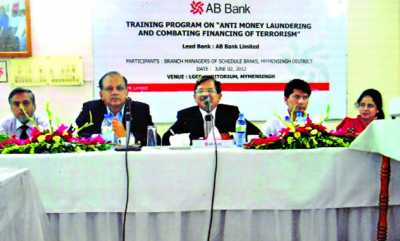 Debaprosad Debnath, General Manager of Bangladesh Bank speaks at a training programme in Mymensingh recently.
AB Bank recently organised a day-long training programme on "anti-money laundering and anti-terrorist financing" in Mymen-singh.
In all, 50 branch managers of scheduled banks under Mymensingh district participated in the training programme, said a press release.
The training covered different aspects of banker's responsibilities and duties in preventing activities related to money laundering and terrorist financing through banking channels.
Debaprosad Debnath, General Manager of Bangladesh Bank inaugurated the training programme as chief guest.
Shamim A. Chaudhury, Deputy Managing Director of AB bank delivered the welcome speech.
The Daily Sun/Bangladesh/ 13th June 2012
BB signs deal with Dhaka Bank on brick field technology
 Nirmal Chandra Bhakta, General Manager of Bangladesh Bank and Khondker Fazle Rashid, Managing Director of Dhaka Bank Limited, sign an agreement in Dhaka.
Bangladesh Bank and Dhaka Bank Limited recently signed a participation agreement on refinancing in Hybrid Hoffman Kiln (HHK) or equivalent Technology of Brick Field.
Nirmal Chandra Bhakta, General Manager, Agricultural Credit and Financial Inclusion De-partment of Bangladesh Bank and Khondker Fazle Rashid, Managing Director of Dhaka Bank Limited signed the agreement on behalf of their organisations, said a press release.
SM Moniruzzaman, Executive Director, Bangladesh Bank and Neaz Mohammad Khan, Deputy Managing Director, Dhaka Bank Limited were also present on the signing ceremony.
The Daily Sun/Bangladesh/ 13th June 2012
Greeks must pay their taxes: IMF
WASHINGTON: IMF chief Christine Lagarde said Tuesday that there is room for easier fiscal policies in Europe's strained economies, but she pressed home again that Greeks must pay their taxes to strengthen their economy.
The International Monetary Fund managing director, who has repeatedly called tax evasion one of Greece's biggest problems, raised the issue again in an interview with CNN television one week before the country holds national elections.
"I think that tax compliance is a necessary tool to restore any country's situation-Greece, like others," she said, according to excerpts released ahead of the broadcast.
But with Greece and other debt-strained eurozone countries struggling without success to restore growth while implementing severe austerity, she suggested that some of the conditions of their bailout programs should be eased.
"You need to reduce the fiscal deficit gradually, steadily," Lagarde said.
"It doesn't have to be this belt-tightening that everybody is talking about, but it has to be solid."
Asked her what she thought of comments last week by international financier George Soros that the eurozone had just three months to fix its problems, Lagarde was less specific but nevertheless signaled a need for action.
"George is very good at setting deadlines and attracting attention, which is good, because there has to be attention paid to the current situation.
"But I think... various things need to happen shortly... more shortly than three months. "It is not to say there is a deadline and the whole situation is going to unravel."
The Daily Sun/Bangladesh/ 13th June 2012
Western Union’s service launched at IBBL
Western Union’s service was launched at Islami Bank Bangladesh Limited at a function at Pan Pacific Sonargaon Hotel, Dhaka Tuesday.
Masud Biswas, General Manager of Bangladesh Bank inaugurated the service as the chief guest.
Mohammad Abdul Mannan, Managing Director of IBBL presided over the programme. Roy Fernandez, Director, Operations, East and South Asia, Western Union attended as special guest. Md. Nurul Islam and Md. Mahbub-ul Alam, Deputy Managing Directors of IBBL also spoke.
Senior officials of Islami Bank and Western Union were present.
Masud Biswas said, Islami Bank actively supports the socio-economic development of the country.
The Daily Sun/Bangladesh/ 13th June 2012