


BB to tighten monetary policy
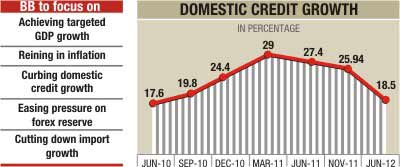
Bangladesh Bank will announce its monetary policy today for the second half of the current fiscal year with a further tightening approach.
A high official of the central bank said the main target of the policy will be to achieve the targeted GDP (gross domestic product) growth and contain high inflation.
This time, the monetary policy will also reflect the recommendations of the International Monetary Fund (IMF) as Bangladesh is going to enter the credit programme of the donor agency after about a decade.
However, another BB official said the policy the central bank took at the beginning of the fiscal year will continue.
Non-food inflation crossed double digits in the recent years and outpaced food inflation for the first time in December.
The BB officials said one of the main targets of the central bank will be to contain non-food inflation.
Point-to-point inflation has been rising at a double-digit rate for a consecutive nine months since March last year.
Such a rare incident was last seen at the beginning of 1980s when inflation grew at a double-digit rate for a long time.
The central bank may also set a target to bring down domestic credit growth below 19 percent by June this year to rein in inflation.
In the first monetary policy of the current fiscal year announced in July the target was 20 percent.
The central bank officials said, to meet the target both public sector and private sector credit growth has to be brought down. However, cutting down public sector credit growth will be a big challenge, they said.
The target for private sector credit growth may be set at 13-15 percent by June next which was 18 percent in the first monetary policy.
The rate of private sector credit growth already came down to 19.33 percent in November 2011 from around 28 percent last fiscal year.
The BB has already taken several steps to contain credit growth. The moves include increasing repo rate and lifting the lending cap. The repo rate may be raised further by June.
To cut loan growth in the unproductive sector, consumers' and housing credit's equity portion of the total amount has been hiked by the central bank recently.
Another target of the monetary policy is to ease pressure on the foreign currency reserve and exchange rate by cutting down import growth.
On January 18 foreign currency reserve was $9.04 billion, down from $10.91 billion on June 30 last year.
The amount of the country's present reserve is equal to 2.87 months' import bill. But according to international standard, keeping the foreign currency reserve equal to a country's three months' import bill is considered as a safe limit.
An IMF report last month said a comprehensive package of macro-policy tightening measures and financial sector restraints is needed to stabilise the economy and avert a near-term balance of payments crisis.
The rapid loss of the central bank reserves over the past few months is expected to continue beyond fiscal 2012 and makes clear that the current policies are unsustainable, with a coordinated policy response essential to restoring macro-economic stability, the report said.
The Daily Star/Bangladesh/ 26th Jan 2012
Slight decline in govt’s bank borrowing
The government’s borrowing from the banking system declined slightly, according to the central bank statistics.
Bangladesh Bank (BB) data show government’s borrowing came down to Tk. 15,664.25 crore, as of January 22, from Tk. 18,000 crore on January 4. The budgetary target of borrowing from banking system in the current financial year (FY) was Tk 18,957.
BB sources said that the latest reduction in government borrowing was a result of adjustment of tax revenues.
However, such borrowing crossed the entire year’s target in just four and a half months because of large spending on subsidy for the power and energy sector and social safety coverage and a fall in foreign aid mobilisation..
From July 1 to November 22, the government had borrowed Tk 20,204 crore from the banking system, which is 638 percent higher than in the same period a year ago. The amount was Tk 1,248 crore more than the borrowing target for the current fiscal year.
Of the total Tk 20,204 crore borrowed, the loan from the central bank alone was Tk 11,167 crore.
Then, revenues worth Tk 3,184 crore in licence renewal and spectrum fees from mobile operators helped the government to reduce the borrowing from the banking sector.
Meanwhile, with this year’s borrowing, the government’s net borrowing from the banking sector reached Tk. 86,800.95 crore.
Economists feared such high borrowing had contributed to escalate the inflation and often suggested the government avoid borrowing from banks.
A recent fiscal coordination committee meeting, chaired by finance minister AMA Muhith also discussed the borrowing and subsidy issues. Sources in the finance ministry said the meeting observed that total domestic credit, including government borrowing from banks, should be reduced to control inflationary pressure.
The source said the borrowing might double if the government did not cut spending and as a result, the revised target might rose to over Tk 25,000 crore.
According to the BB source, the government’s income remains stagnant because of having inadequate response with regard to earnings from savings instruments, mobile operators and aid from donors.
Meanwhile, net foreign aid mobilisation has fall drastically. The projection of the government was to receive Tk 13,058 crore in foreign aid.
Sources say the earning from the tax revenue is the last resource for spending that couldn’t comply with the demand for money that drives the government to borrow from banking sector.
According to the finance ministry, the budgetary allocation for subsidy was Tk 20,477 crore, but the ministries demanded Tk 46,000 crore even after price adjustments.
The ministry projected that the probable requirement for subsidy may stand at Tk 35,000 crore after cutting down the subsidy demand. For the agriculture sector, the additional demand is Tk 11,600 crore which may be cut down to Tk 8,000 crore.
The demand of the Power Development Board (PDB) is Tk 10,000 crore but it may be kept limited to Tk 7,000 crore.
Bangladesh Petroleum Corporation (BPC) has asked for Tk 16,700 crore even after price adjustment, but the finance division projection is not to cross Tk 12,000 crore for the BPC.
The Daily Independent/Bangladesh/ 25th Jan 2012
DBBL holds managers’ conference
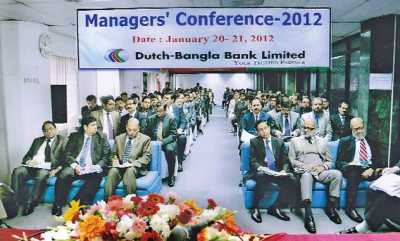 KS Tabrez, managing director of Dutch-Bangla Bank Ltd, presides over the ‘1st Managers’ Conference-2012 recently.
The 1st Managers’ Conference – 2012 of Dutch-Bangla Bank Limited (DBBL) was held recently to review Bank’s performance for the year 2011 and to discuss the business plan for the year 2012.
KS Tabrez, managing director of the Bank, presided over the conference, said a press release.
Deputy managing directors Abul Kashem Md Shirin, Md Sayedul Hasan, Khan Tariqul Islam, Md Mosaddiqur Rahman and all divisional heads and senior executives of head office of the Bank were also present. About 111 branches managers attended the conference.
The Daily Sun/Bangladesh/ 25th Jan 2012
SIBL launches campaign for unity
 Muhammad Ali, managing director of Social Islami Bank Limited, inaugurates a campaign in the city recently.
Social Islami Bank Limited (SIBL) launched a new campaign - “United we stand” to uphold the image and popularity of the Bank through united and coordinated efforts of its employees.
Muhammad Ali, managing director of the Bank inaugurated the campaign recently by handing over the logo of the campaign to the manager of foreign exchange branch and manager operation of principal branch at its corporate office in the city, said a press release.
Md Shafiqur Rahman, AMM Farhad, Mohashin Miah, deputy managing directors of the bank and heads of division of corporate office were present at the function.
The Daily Sun/Bangladesh/ 25th Jan 2012
Citibank hands blankets to Red Crescent
 Rashed Maqsood, managing director and country officer of Citibank, Bangladesh hands over blankets to Prof Dr M Serajul Akbar MP, chairman of BDRCS recently.
Citibank, NA, Bangl- adesh recently donated 1200 blankets to the Bangladesh Red Crescent Society (BDRCS) for distributing to cold-hit people.
The blankets will be distributed among the cold heated people of the northern and north-western region part of our country, said a press release.
Rashed Maqsood, managing director and Citibank country officer of Bangladesh, officially handed over blankets to Prof Dr M Serajul Akbar, MP, chairman of the society to support their countrywide relief effort.
Officials from both organisations were present during the event.
The Daily Sun/Bangladesh/ 25th Jan 2012