


BB signs deal with S’porean firm to install NPS
Bangladesh Bank has taken initiatives to set up the National Payment Switch (NPS) to modernise the existing electronic payment system.
The central bank has signed an agreement with ‘Infotech Global Private Ltd’, a Singapore-based company on Thursday to implement the project.
The NPS project is being implemented BB under the ‘Central Bank Strengthening Project’, financed by the World Bank.
The NPS is included with the national information and communication technology policy-2009 of the government.
Project Director of NPS and Executive Director of BB, Md Ahsan Ullah presided over the signing ceremony where BB’s Executive Directors-- Dasgupta Ashim Kumar, Md Abdul Hamid and other senior officials of BB and Infotech Ltd were also present.
Infotech was given the contract through an open international tender.
IBCS Primax Bangladesh Ltd, a local IT firm, has been working with this project as the local representative in implementing the project.
The Daily Sun/Bangladesh/ 27th Jan 2012
Atiur dispels CRR rumour
The central bank yesterday refuted rumours on slashing the cash reserve ratio (CRR), which is the amount of cash that banks have to hold in reserve.
“It will be considered only after the inflation rate comes down to 7-8 percent,” Dr Atiur Rahman, the central bank governor, told reporters at the launch of the monetary policy statement for January-June.
It was rumoured in the money and capital markets that Bangladesh Bank would reduce the CRR by 50 basis points to 5.5 percent after India's central bank did so on Wednesday. The stockmarket bounced back on that day.
If the CRR is reduced by 50 basis points, nearly Tk 2,000 crore will come into the cash-strapped banking industry, according to the central bank.
But inflationary pressure troubles BB.
The point-to-point inflation came down to 10.63 percent in December from nearly 12 percent in September, mainly due to a decline in food prices.
“However the fact that non-food inflation is still steadily increasing suggests that the focus on bringing inflation to a single digit needs to continue,” Rahman said.
Tight liquidity forced banks to collect deposits at up to a 15 percent rate to maintain the loan-deposit ratio within 85 percent. But banks lent more than the regulatory limit and are now trying to match it by increasing deposits.
The Daily Star/Bangladesh/ 27th Jan 2012
Pressure on forex reserves to ease in months: BB
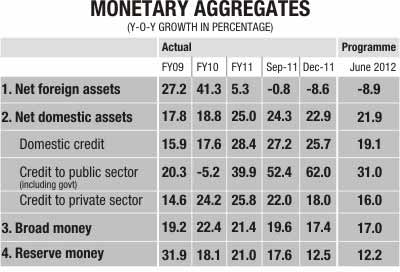
The central bank yesterday said the pressure on foreign exchange reserves would ease in the coming months due to a fall in the opening of new letters of credit and restraints on domestic credit environment that is expected to limit import growth further.
The Bangladesh Bank said the number of LC openings fell 8 percent in January compared to the same period a year ago.
A more restrained domestic credit environment will cut down import growth, the BB said in its Monetary Policy Statement for the second half of the current fiscal year.
The weaker taka will support export and remittance growth, the central bank said in the MPS released yesterday.
The central bank said the recent trends suggest that the pressure on foreign exchange reserves would ease in the coming months.
“We expect that new external sector equilibrium will be reached soon," the BB said.
On January 18, foreign currency reserve was at $9.04 billion, down from $10.91 billion on June 30 last year.
The BB also said the external sector is facing a challenging environment, and addressing this is an integral part of the bank's monetary stance.
Export growth, which was 14.7 percent during July-December last year, lagged behind the import growth at 22 percent between July and November, partly due to the projected 57 percent rise in petroleum imports in fiscal 2012 compared to the previous year.
November 2011 witnessed a negative current account balance for the first time in recent years as the negative trade balance was not compensated by remittances that grew by a robust 9.3 percent in the first six months of the current fiscal year, the BB said.
It said a sharp decline in net foreign aid (total aid minus payments) is another major reason behind the mounting pressures on the balance of payments.
The net aid for the July-November period in 2011 was $69 million, which accounted for only 7 percent of that received in July-November 2009.
"As a result of these multiple pressures, the exchange rate has depreciated, with the taka's value falling by around 15 percent vis-a-vis the US dollar in the twelve months preceding mid January 2012. The foreign exchange reserves have also fallen from $10.1 billion in to 9.2 billion during this period."
The central bank said remittances appear to have responded positively to the depreciation of the taka.
Migrant workers sent home a monthly record of $1.15 billion in December last year. Data from the first half of January points to a similar figure repeating itself, the BB said.
The central bank also said the fiscal stance is supportive of the government's growth strategy but the lack of foreign aid and unanticipated spending pressures have led to rapid growth of borrowing from the banking sector.
This reflects significant shortfalls in foreign borrowing, higher-than-expected subsidy payments and low levels of non-bank borrowing.
The non-bank borrowing can be enhanced if upward revisions to the interest rates on national savings schemes are made, the BB said.
The rising subsidy costs are piling up pressures on the government's domestic financing requirement, as state-owned enterprises providing fuel and electricity continue to make large losses, despite recent fuel and electricity price increases.
The subsidy is estimated at 3.4 percent of GDP or 19.1 percent of total spending in fiscal 12 compared to 1.3 percent of GDP or 8.8 percent of total spending in fiscal 2010.
Inflation, which was 10.7 percent in December, is much higher than the 7.5 percent average projected in the current budget due to a number of factors including higher food prices globally, high domestic credit growth and recent upward adjustments in energy and petroleum prices.
Point-to-point inflation declined from a peak of 11.97 percent in September to 10.63 percent in December. However, non-food inflation is still steadily increasing, partly due to energy and petroleum price adjustments.
The BB suggests that the focus on curbing inflation to single digit levels needs to continue.
The Daily Star/Bangladesh/ 27th Jan 2012
BB spells out five steps to keep economy on track
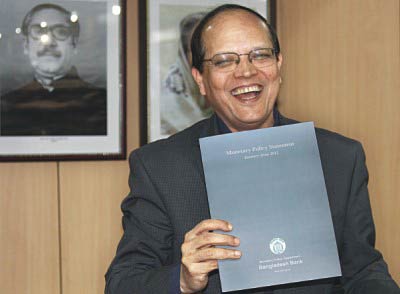 Atiur Rahman
The central bank has announced five steps that include hiking interest rates on savings certificates, mobilising more external and domestic resources and rationalising public expenditures to implement its monetary policy.
The plans came as Bangladesh Bank Governor Atiur Rahman yesterday announced the bank's Monetary Policy Statement for the second half of the current fiscal year, which tightened the policy further to curb soaring inflation and reduce pressure on rocketing exchange rate.
"Ensuring positive real interest rates will strengthen monetary transmission channels, curb non-essential imports, stabilise external reserves and lead to an equilibrium in exchange rate," said the governor at a press briefing at his office in Dhaka.
First, the central bank said there is scope for increasing private sector credit growth for productive investments beyond the programmed level if there is a reduction in growth in credit to the public sector.
The BB also said it plans to reduce the demand for consumer loans to increase the share of lending going towards growth-enhancing investment purposes.
"We will discourage investment in risky sectors. We, however, do not mean investment in stockmarket as risky," Allah Malik Kazemi, a senior consultant of the central bank, told journalists after the briefing.
"There are many loans in the SME (small and medium enterprise) sector that are risky."
Second, the BB will ensure liquidity support for banks, so that productive credit growth is not crowded out. In future, the government's borrowing calendar will need to be modified to allow for a higher percentage of debt auctions in Treasury bills, as the long dated Treasury bonds lack liquidity in the absence of an active secondary market.
Third, while the interest rate regime will remain liberalised, the central bank will focus more on monitoring interest rate spreads so that they remain below 5 percent except for SME lending (as the costs of SME operations are higher) and consumer lending.
Fourth, the central bank said, in order to reach the new external sector equilibrium, overall import demand needs to be rationalised. Opening of letters of credits for non-essential and luxury items will be discouraged, while those for essentials such as petroleum will be unhindered.
The BB said a new coordination committee would aim to ensure that taka liquidity is provided ahead of time so that banks can purchase the needed foreign exchange on the inter-bank market on a regular basis.
As a result, lumpy Bangladesh Petroleum Corporation payments can be met instead of approaching the BB for foreign exchange.
Fifth, the central bank will take further steps to improve the stability and outreach of its financial system.
The BB also said the monetary growth targets for fiscal 2012 are on track that established the credibility of the stance taken in the previous MPS.
In November 2011, reserve money growth and broad money growth were 15.4 percent and 17.7 percent respectively, well below the 16 percent and 18.5 percent targets set out in the July MPS.
"This stance was achieved through open market operations, raising the repo rates by 100 basis points in FY 2012 and lifting caps on lending interest rates other than for agricultural and pre-shipment export credit," said the MPS.
While weighted average lending rates have gone up on average by 1.6 percentage points in 2011, the BB said it is closely monitoring spreads so that they remain in low single digits for all sectors, except SME and consumer credit.
"This stance, along with pro-active liquidity management still ensured adequate year on year private sector credit growth -- more than sufficient to sustain economic growth targets, in line with earlier years and above that of India."
The BB said the extent of crowding out is limited as the weight of government borrowing in total domestic credit remains around 20 percent, which will free up more room for private sector credit growth.
It also said cross-country experiences from around the region illustrate the importance in Bangladesh of using monetary policy to act preemptively to mitigate risks from domestic and external imbalances.
The Daily Star/Bangladesh/ 27th Jan 2012
MTB OPENS BOOTH AT DEPARTURE LOUNGE OF HSI AIRPORT, DHAKA

Md. Atharul Islam, Secretary, Ministry of Civil Aviation & Tourism formally inaugurated the MTB booth at the departure lounge of Hazrat Shahjalal International Airport (HSIA) Dhaka, as the Chief Guest. Chairman of the Civil Aviation Authority of Bangladesh, Air Commodore Mahmud Hussain ndc, psc, MTB Chairman Dr. Arif Dowla and Vice Chairman Rashed A Chowdhury, Mr. Kamaluddin Ahmed, FCA, FCMA, Director Finance, Biman Bangladesh Airlines attended the program as Special Guests. MTB Managing Director & CEO Anis A. Khan, Additional Managing Director Md Ahsan-uz Zaman, Head of MTB NRB Banking Division AKM Shameem, other senior Government and bank officials were also present at the event .
Source:http://www.facebook.com/Mutual.Trust.Bank