


Banking
Next monetary policy to focus on taming inflation: Atiur
SIRAJGANJ: Bangladesh Bank (BB) Governor Dr Atiur Rahman said the next monetary policy would have a strategy of ensuring credit flow to productive sectors with an aim to tame up the inflation through increasing the supply of essential commodities as per the demand.
“We’ve asked all banks to increase credit flow to productive sectors to minimize inflationary pressures side by side with taking various steps to discourage import of luxurious goods and reduce credit to this sector,” said the BB governor while addressing two separate loan distribution programmes here Saturday.
On July 18, the central bank will announce its half-yearly monetary policy statement for the first six months of the financial year 2012-13 (FY13), he added.
Dr Atiur will announce the policy at a press conference at the central bank’s headquarters in the capital city at around 11 am, official sources said.
The BB will maintain its contractionary monetary policy for the next six months to bring the inflation down to the fiscal target of 7.5 percent from the current double-digit position, a BB official told BSS.
The policy would remain cautious so the credit flow to the private sector maintains its expansion with creating new job opportunity to propel GDP (gross domestic product) growth, which is targeted at 7.20 percent for the FY13.
According to BB, the credit flow to the private sector was 18.22 percent in April. Dr Akhtaruzzaman said the credit flow, which was in line with the neighbouring countries, indicated that the fear of decline in credit flow due to the “restrained” monetary policy proved unfounded.
The Daily Sun/Bangladesh/ 15th July 2012
ICCB chief warns of credit crunch Mahbubur Rahman suggests better treasury management
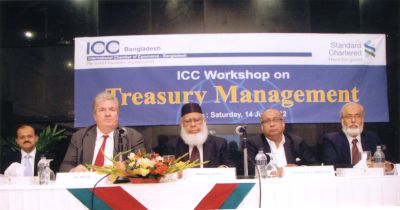 From left, Samiran Chakraborty, head of research at Standard Chartered Bank Mumbai; Jim McCabe, chief executive officer of StanChart Bangladesh; Mahbubur Rahman, president of International Chamber of Commerce Bangladesh (ICCB); Muhammad A (Rumee) Ali, chairman of BRAC Bank, and Ataur Rahman, ICCB secretary general, attend a workshop on treasury management, organised by ICCB, in Dhaka yesterday.
The private sector is not getting enough credit for working capital as banks are going through a liquidity crisis, the president of International Chamber of Commerce Bangladesh said yesterday.
So it is essential for bankers to learn more about the treasury management for proper utilisation of limited funds, said Mahbubur Rahman.
He spoke at a workshop on treasury management, organised by the chamber and supported by Standard Chartered Bank, at a local hotel in Dhaka. Despite the global recession, the developing Asia's growth in 2011 was recorded at 9.5 percent, he said.
Asia, with a solid global market and a large pool of foreign exchange reserves, has proven to be the shining light in a gloomy and uncertain world economy, according to experts.
"Asia's prospects are likely to be affected by the West. However, it is opined that the rising Asia appears to be able to help save the world from the shrinking economy," according to a statement of the chamber.
In line with Asian economies, Bangladesh's performance has so far been quite resilient to global economic meltdown, Rahman said, adding that the country's macroeconomic performance was better than expected and regionally its performance had been one of the best.
He mentioned that treasury management is the management of cash, fund, currency, bank and financial risk.
"So, it is an imperative tool of finance. It handles actual cash management at companies, and one of its main functions is to establish the optimum cash level so that payments can be made and received as necessary for the proper operation of the company."
Besides, another main function of treasury management is to maintain the liquidity of business, Rahman said.
Without proper liquidity, it is risky for business to operate smoothly and it is also the function of treasury management to minimise the currency risk, he said.
For this, treasury managers touch with currency market of world, he said, adding that the managers analyse the reason of crisis in currency market.
"Sometime this crisis will be benefited for them because they have to pay less to other country for getting their service at cheap rates."
The recent manipulation of London Interbank Offered Rate in UK created panic among the consumer of the banks and "its ultimately spreading all over the world", said Muhammed A (Rumee) Ali, BRAC Bank chairman and vice chairman of Bangladesh Association of Banks.
"Recent change in provisioning requirement by our central bank for the commercial bank may compel banks to draw upon their capital to meet their requirements."
He suggested the central bank to make details study on it. Bangladesh Bank should also have to train its officials for providing exact information, Ali said.
Global economic turbulence led to realignment and changes in global financial architecture, said Jim McCabe, chief executive officer of Standard Chartered Bank.
"StanChart has weathered this storm much better than most of our peers worldwide. This gives us a vantage point in guiding financial innovation in a manner which is sustainable by combining our global capability, deep local knowledge and creativity. Our effort today is towards that end."
The workshop with 60 participants was jointed conducted by Samiran Chakraborty, head of research for Standard Chartered Bank, Mumbai; Alamgir Morshed, head of global markets of Standard Chartered Bank, Bangladesh, and Biswajeet Sengupta, head of financial market sales for Bangladesh and Eastern India.
The Daily Star/Bangladesh/ 15th July 2012
Why is the response to economic crisis not more serious?
The state of the world economy these days reminds me of the famous telegram from an Austrian general, responding to his German counterpart toward the end of World War One. The German described the situation in his sector of the Eastern front as “serious but not catastrophic”. In the Austrian sector, the reply came, “the situation is catastrophic but not serious”. In much of the world today the economic situation is verging on catastrophic, but “not serious” seems a perfect description of the political response.
Four years after the Lehman crisis, economic activity and employment in the OECD has not yet returned to its pre-crisis level. Unemployment is at postwar highs in every major European country apart from Germany and, while the US jobless rate is now a little below its postwar record, it has been stuck above 8 percent for longer than at any time since the Great Depression. And in Britain, the long-term loss of output assumed by the government's latest budget forecasts implies, according to Goldman Sachs calculations, that the six months of the post-Lehman crisis did greater permanent damage to the country's productive capacity than the Great Depression or World War Two.
Now consider the response. In the US, the four years since Lehman have been dominated by economic debates among politicians, media commentators and business leaders on issues that are almost totally irrelevant to unemployment and the pace of economic recovery: how to reduce long-term budget deficits and whether to tweak the top rate of income tax from 36 percent to 39.6 percent. In Britain, the biggest economic controversy this year has been the extension of value added tax to hot pies. Europe's response to the deepest economic depression in living memory -- and an even more alarming xenophobic nationalism that threatens the literal disintegration of the euro and the European Union --has been to debate the bureaucratic “modalities” of bank regulations, fiscal treaties and pension reforms in the next decade.
How to explain this insouciance in the face of the gravest threat to the Western world since the height of the Cold War? In the US and Britain the answer is straightforward, if unappealing: party politics. In Britain, the Conservative-Liberal coalition has managed to lay all the blame for the country's economic troubles on Labour's Gordon Brown, so far at least. Thus there has been very little public pressure on the Cameron government to change its economic policies, and no political advantage in doing so.
In the US, the Obama administration's efforts to revive the economy with public spending have been stifled by congressional Republicans, while Democrats have thwarted conservative ideas about using tax cuts to stimulate enterprise, investment and consumption. Business leaders and media opinion-formers have aggravated this political impasse by whipping up fears about budget deficits, despite the record-low yields set by the markets on US Treasury bonds.
The good news is that US politics created a self-stabilising feedback of sorts. If the US economy continues to deteriorate, the Republicans will probably win both the presidential and congressional elections and would then be free to pursue an aggressive tax-cutting policy modelled on Reaganomics. Big tax cuts would doubtless increase budget deficits, but they might well pull the US out of recession as they did in 1983. If, on the other hand, the US resumes tolerable levels of economic growth and employment creation, then a re-elected Obama administration would have a strong mandate to overcome or co-opt what would then be a chastened Republican opposition.
Now for the bad news, which comes, of course, from Europe. The euro zone, in contrast to the US and Britain, is paralysed not by cynical political calculations but by profound misunderstandings of economics and finance. European leaders do not seem to understand that the fiscal and banking unions they are relying on to save the euro can only work under a very specific political condition: Restrictions on national sovereignty over budgets and bank regulation (as demanded by Germany and resisted by France, Italy and Spain) have to be agreed on at the same time as mutual support for debts (as demanded by France, Italy and Spain, and resisted by Germany). Moreover, the banking and fiscal unions can only work if they are backed by a central bank commitment to buy government bonds and thereby maintain near-zero interest rates for a long period, as in the US and Britain.
Anatole Kaletsky is an award-winning journalist and financial economist who has written since 1976 for The Economist, the Financial Times and The Times of London before joining Reuters.
The Daily Star/Bangladesh/ 15th July 2012
IBBL holds orientation programme .
Islami Bank Bangladesh Limited (IBBL) organised a day-long orientation programme for 160 newly-appointed assistant officers Tuesday at Mohammad Yunus Auditorium of Islami Bank Tower in Dhaka.
With Managing Director Mohammad Abdul Mannan in the chair the programme was also attended by Executive Committee Chairman of the bank Engineer Eskander Ali Khan, said a press release.
The programme was attended, among others, by Deputy Managing Directors Md Shamsul Haque, Md Habibur Rahman, Md Nurul Islam, Muhammad Abul Bashar and Syed Abdullah Mohammad Saleh.
Abdus Sadeque Bhuiyan, Executive Vice President and Head of Human Resources Division, delivered the welcome speech and Abu Taher Mohammad Saleh, Executive Vice President and Director General of Islami Bank Training and Research Academy thanked the audience.
The Daily Sun/Bangladesh/ 14th July 2012
WB backs Ethiopia-Kenya power lineHRW concerns over environmental damage
WASHINGTON: The World Bank yesterday approved a controversial project to link the Ethiopian and Kenyan electricity grids, which has been criticized by lobby groups because of environmental and human rights concerns.
The World Bank board gave the roughly 1,000-kilometer (620-mile) transmission line the green light, saying it would reduce costs, promote renewable energy sources and improve cooperation in East Africa.
The line is part of a nearly $1.3 billion project to link energy-producing Ethiopia with Kenya—where as many as 80 percent of the population is without power.
The World Bank is stumping up a loan of around $684 million for the project.
On the eve of the World Bank decision, advocacy group Human Rights Watch urged the bank president Jim Yong Kim to hold fire.
“The World Bank needs to rigorously apply its social and environmental safeguards,” a letter to Kim stated.
“Human Rights Watch has very serious concerns that the World Bank has failed to do so as the project currently stands.”
HRW said the dam that will be the likely source of the power in Ethiopia—which is not funded by the bank—could cause serious environmental damage to Lake Turkana, a UNESCO world heritage site.
HRW said the dam project has also resulted in a swathe of “abusive involuntary resettlement” of local groups.
While the World Bank says that more than 5,000 people will be directly affected by the power project, it stresses the dam project is not directly linked and energy will come from a large number of existing and future power plants in Ethiopia.
Human Rights Watch has been vocal in its criticism of the Ethiopian government for its policy of “villagization,” which it claims has resulted in a wave of forced relocations.
The transmission project is part of a broader plan to link the electricity grids of Ethiopia, Kenya, Rwanda, Tanzania and Uganda, spurring growth and saving East African nations around $1 billion a year in energy costs.
The Daily Sun/Bangladesh/ 14th July 2012