


Four SoBs suffer 45pc of classified loan
Four state-owned banks (SoBs)- Sonali, Agrani, Rupali and Krishi Bank- currently suffer 45 percent of total classified loans in industrial sector of the country, showed Bangladesh Bank data.
The total classified loan in the sector stood at Tk 71.54 billion early in the current fiscal, which is 5.26 percent of total outstanding loan.
Bangladesh Bank (BB) data also showed that the privately-owned banks have 30.80 percent of classified loan while the foreign banks 2.38 percent and private specialised banks 11.95 percent and other financial institutes have 9.29 percent.
Former Finance Adviser to a caretaker government Dr. AB Mirza Azizul Islam told daily sun that classified loan and its slow recovery is nothing new for the state-owned banks.
He said state-owned banks don’t conduct any adequate study and scrutiny before providing loans, at one hand, and distribute a significant amount of loans under political consideration, on the other hand, increasing the likeliness of the loans to be classified.
“The political influence also makes the loan recovery difficult for the state-owned banks,” said Dr Mirza Aziz.
He said: “Although Bangladesh Bank initiatives such as enacting laws helped to improve the situation slightly, the current statistics are bleak again.”
The liquidity crisis slowed down the credit flow in the commercial banks during the second half of the last year, said the senior officials of the commercial banks.
According to BB data a total of Tk. 541.62 billion was distributed as industrial credit during the last six months of 2011. Of the amount, the operating capital was Tk 368.57 billion while the term loan amounted to 173.05 billion.
The data said total industrial credit during the same period of 2010 stood at Tk 525.36 billion.
As the figures showed, the total recovery of industrial credit during the last six months of 2011 was Tk 470.28 billion. The running capital amounted to Tk 318.57 billion and the term loan reached Tk 151.71 billion during the period.
The BB figures also said the classified loan in industrial sector during the second half of 2010 stood at Tk.73.82 billion which is now Tk 71.54 billion, marking a decline of 3.9 percent.
According to the central bank’s officials, there were various steps taken to reduce the amount of classified loans and the commercial banks complied with the BB directives to implement the steps, thus being able to reduce the amount.
During the second half of 2011, the amount of expired loan stood at Tk 127.60 billion which is 9.39 percent of total credit in the industrial sector.
Of the amount, the running capital was Tk 62.78 billion and the term loan was Tk 64.82 billion.
The classified loan during the period also marked a rise by 13.43 per cent from the amount of the same period a year ago. The classified loan Tk 112.49 billion during the last six months of 2010.
The Daily Sun/Bangladesh/ 12th March 2012
A banker who changed the game The chief executive of UCB talks about his strategy that turns the bank successful
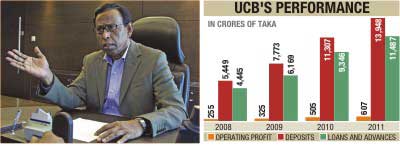 M Shahjahan Bhuiyan
When the banking industry is grappling with high cost of funds and going with higher lending rates, a top banker said the soaring costs of borrowing will threaten the entrepreneurs and the overall economy in the days to come.
“Doing business is becoming costlier as the borrowing cost is getting dangerous. This will have a significant impact on the economy,” said M Shahjahan Bhuiyan, managing director of United Commercial Bank, popularly known as UCB.
He was sharing his thoughts on the banking industry in Bangladesh and the regulator's role in helping the sector grow in an interview with The Daily Star at the Bank's headquarters in Gulshan recently.
“To stop making local products uncompetitive, the regulator should come up with some control over the Banks on the rising borrowing costs,” said Bhuiyan who has been in the banking industry for more than 40 years.
He said some industries have already been affected and are being shut down. The UCB boss also talked about the recent exchange rate volatility where he smells manipulation.
Leading business bodies and entrepreneurs have already raised the issue and expressed their concern. They said after the central bank withdrew the cap on lending rates in the last quarter of 2011 commercial banks started to increase the lending interest rates up to 18 percent. Even the Banks have increased interest rates for the loans taken a year or more ago.
Bhuiyan's stand may puzzle many bankers, but he argued on strong logical ground.
Why have some banks been facing a liquidity shortage? Why does their cash flow get squeezed? Why are they borrowing from the overnight call money market at higher rates?
He said: “It was because of their (Banks) imprudent activities. They invested heavily on speculative market bypassing core banking investments.”
“Some banks mismatched their asset-liability management.”
Borrowers took their industrial or working capital loans straight to the stockmarket and banks failed to supervise those misdeeds, which he said had an impact on some banks' cash flow.
He called upon the central bank to carry out an investigation into the banks that are taking deposits at higher rates.
Bhuiyan is a luminary in the banking business. After graduating from Dhaka University he joined the then State Bank of Pakistan in 1970. He worked in Pubali Bank for 16 years before switching to City Bank and UCB in different senior positions. He then served Prime Bank for nine years, of which five and a half years as managing director.
He joined the trouble-torn UCB in 2008 as its managing director and magically turned the Bank into a very successful one.
Deposits, loans and advances have gone up nearly four times between 2008 and 2011. Non-performing loan which is an important indicator in assessing a Bank's soundness has come down to less than 2 percent in 2011 from 4.62 percent in 2008.
Bhuiyan recently won the country's first-ever best banker award for his outstanding contribution to steering the troubled-bank into a profitable one.
Now Bhuiyan dreams even bigger -- to turn the Bank into a model financial institution.
What magic he has played?
“Though late, the board has understood that the Bank is missing out huge business potential,” said Bhuiyan.
“They (directors) are young, professional businessmen and understand the economy. All they needed a confident and efficient management,” he said. “This mixture has worked and the board has seen that it is yielding results for the Bank.”
He said, a lot of customers who left the Bank for its poor services, started coming back. Now customers are marketing for the Bank.
All he had to do was an overhaul of the employees' mindset and policies and setting up the goal. He tried to bring a dynamic and enthusiastic environment in the working process.
“UCB as a first generation private bank earlier did not recruit employees on the basis of merit. So, they failed to net and deliver customers,” he said.
To him, training the employees is a continuous process. “Not only training, they must be given incentives to be inspired to deliver their best,” he said, citing an example of welfare fund established for the employees. He also introduced performance-based incentives and promotions for the employees.
He holds high hopes about Bangladesh. According to him, there is no dearth of ideas, businesses and manpower in the country. Banks have a role to advise and guide new entrepreneurs as they did in flourishing apparel industries in the country, he said.
“Man will get old and die, but not an organisation. A good institution has to adjust with the changes to deliver efficiently.”
The Daily Star/Bangladesh/ 11th March 2012
MTB opens ATM booth in Jessore
 A K M Shameem, Principal of MTB Training Institute, inaugurates the Bank’s 79th ATM booth in Jessore recently.
Mutual Trust Bank Limited (MTB) recently opened its 79th ATM booth in Jessore.
AKM Shameem, principal of MTB Training Institute, formally inaugurated the booth as chief guest, said a press release.
Head of MTB Wholesale Banking Syed Rafiqul Hossain, the Bank’s senior official Liaquat Ali, local business man Zaman, physician Saiful Islam and journalist Mobin Khan, among others, were also present at the function.
A K M Shameem said MTB is committed to provide modern banking services to the customers.
The Daily Sun/Bangladesh/ 11th March 2012
City Bank plutinum sponsor of Wasfia’s Everest Expedition
 City Bank Chairman Rubel Aziz yesterday handed over a Bangladeshi flag to mountaineer Wasfia Nazreen, who leaves country today for her Mount Everest Expedition.
Wasfia Nazreen, a Bangladeshi mountaineer, is set to leave country today to climb to the summit of the Earth's highest Mount Everest as her third expedition after having reached two other highest peaks of two continents.
City Bank Limited has joined the Mount Everest Expedition of Wasfia as its Platinum Sponsor while Renata Limited and Kazi Farms Limited are Gold Sponsors, says a press releas.
A ‘flag-off’ ceremony was held at City Bank Centre banquet hall in the city yesterday on the occasion.
Rubel Aziz, City Bank’s Chairman, handed over a flag of Bangladesh to Wasfia at the function, which she will carry to the summit.
Wasfia will traverse the mountain from South side, the classic route taken by Edmund Hillary, which is considered the more difficult route than the North side.
The Daily Sun/Bangladesh/ 11th March 2012
Pricier fuel triggering inflation: BB
Hike in prices and increase in the demand for fuel oil are the main reasons behind inflation, the Bangladesh Bank believes. ”Basically hikes in prices of necessities in the international market and fuel oil in local market, along with increased demand for fuel oil, appear to be the main reasons for inflation,” the central bank says in a recent report on the economy.
According to the report, the average inflation rate in the past 12 months ending in January was 11.59 per cent; while the rate was 10.91 per cent on a point-to-point basis. The inflation rate for an average of past 12 months had been 9.04 per cent in January last year, with point-to-point inflation at 8.14 per cent. According to the central bank, the import of all the products except fuel oil has dropped in the first seven months (from July to January) of the current fiscal.
In that time, the number of L/Cs (letters of credit) opened to import rice has decreased 73 per cent, to import capital machineries fell 33.22 per cent and to import industrial raw materials, dropped 9.32 per cent from the previous financial year. On the other hand, the number of L/Cs opened to import fuel oil has increased a staggering 93.23 per cent, the central bank revealed. Finance minister Abul Maal Abdul Muhith, however, said the government was trying to keep the inflation rate at a tolerable level.
On March 4, he presented a report in parliament titled ‘Budget 2011-12: Implementation, Progress, Income-Expenditure Trend and Macroeconomic Analysis of the 1st Quarter (From July to September)’. In the report, he said the average inflation rate in those three months was 11.41 per cent, which had been 7.6 per cent during the same period last fiscal.
The rate was seeing an upturn, he said and reasoned food inflation as the cause. The inflation of commodities, other than foods, also put pressure on the general inflation rate, Muhith said. The report reads that the hike in prices of fuel oil and food in the international market, additional flow of loans and limitations of supply were fuelling inflation. However, the prices of fuel oil have dropped in the international market.
According to International Monetary Fund (IMF) forecast, the prices of fuel oil would come down at $100 per barrel by end of 2012. The finance minister’s report expressed hope that the bumper production of Boro crops and the possibility of satisfactory growth in the agriculture sector will play a positive role in reducing the possible inflation pressure in the current fiscal.
”The good news for us is that we do not need to import rice. With the reserve rice, I don’t think that we will need to import anymore in the next few days,” former adviser to the caretaker government A B Mirza Azizul Islam told bdnews24.com. ”Our (the country’s) inflation now basically depends on fuel,” he added. He said prices of fuel oil have experienced hikes several times in the tenure of the incumbent government.
“The demand for fuel oil has also increased due to its usage at the power plants.” ”Fuel oil is such a commodity whose price hikes impact almost all other commodities including transport cost. The same thing is happening here,” he added.
The Indepedent/Bangladesh/ 10th March 2012