


Black money welcome in stocks Muhith says other facilities for investors will remain same in FY13
 Finance Minister AMA Muhith speaks at a consultative committee meeting on the national budget 2012-13 at a hotel in Dhaka Thursday.
Finance Minister AMA Muhith on Thursday said the government would continue to allow investment of black money in the stock market throughout the next fiscal.
“There is a provision in the Income Tax Act which allows legalising black money. We are working to make the provision more effective,” Muhith said.
He also said the government would provide incentives to four sectors including skilled labour, maize cultivation, seed production and poultry industry considering their prospects.
The minister was addressing a consultative committee meeting on the national budget 2012-13, jointly organised by the National Board of Revenue (NBR) and Federation of Bangladesh Chambers of Commerce and Industry (FBCCI) at a hotel in the city.
“The existing facilities for the stock market investors will remain the same. Some reformations in the stock market including demutualisation will also be initiated,” Muhith said.
FBCCI President AK Azad earlier opposed the opportunity to legalise black money by paying 10 percent tax. “It will discourage the regular tax payers. If the government decides to allow whitening black money, higher monetary fines should be realised in this process. Otherwise, it will cast negative impact on revenue earning,” AK Azad said.
FBCCI placed a 448-point proposal including 194 points on import tax affairs, 107 on Value Added Tax (VAT) and 147 on income tax affairs for the upcoming national budget at the meeting. While addressing the meeting, the finance minister said though the government intends to promote local industry, it would also keep an eye on imports since the country is unable to fulfill the demands for many goods by its own.
“We are working to create a balanced environment for both the manufacturers and importers by imposing taxes on production, assembling and final products,” Muhith pointed out. He said the government would set a target to lower the inflation to 7.5 percent in the next fiscal from existing 9 percent.
Muhith said they expect the economic growth to be 7.2 percent in the upcoming fiscal, which is 6.7 percent in the current fiscal.
“I think our expectation is not so high considering our growth in the last few years,” he added.
The finance minister expressed his firm hope to start construction of the Padma Bridge within the next fiscal year.
“There is no doubt that the construction of the bridge will be started within the next fiscal. Nothing to worry about financing,” Muhith said. He said the pre-shipment inspection (PSI) system for imported goods will be abolished within the next seven months to make customs activities more convenient for the businessmen. Muhith, however, said the some products would still be scanned under the PSI system.
NBR chairman Dr Nasir Uddin Ahmed presided over the meeting, which was also attended by lawmaker Golam Dastagir Gazi, FBCCI senior vice president Md Jasim Uddin, vice president Mostafa Azad Chowdhury Babu, former president Md Akram Hossain, former senior vice president Abul Kashem, Dhaka Chamber of Commerce and Industries (DCCI) President Asif Ibrahim, BGMEA President Shafiul Islam Mahiuddin and Exporters Association of Bangladesh President Salam Murshedi.
The Daily Sun/ Bangladesh/ 18th May 2012
Bad loans pile up as business slows
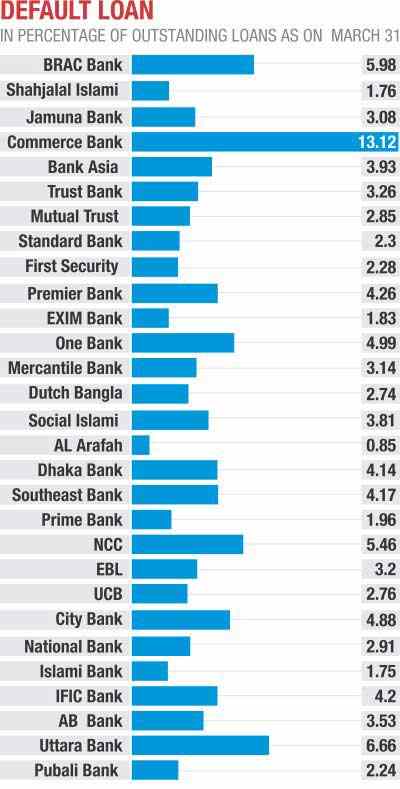
The amount of default loans increased by Tk 2,645 crore or 11.68 percent in public, private and foreign commercial banks in the first quarter of 2012.
Officials said a sluggish trend in business was the main reason behind the rise in such loans.
According to Bangladesh Bank (BB) statistics, banks had default loans worth Tk 25,298 crore or 6.57 percent of their outstanding loans on March 30, up from Tk 22,644 crore or 6.12 percent on December 31, 2011.
Of the total default loans, the amount in four state-owned commercial banks went up by Tk 950 crore or 10.35 percent.
Such loans in 30 private banks increased by Tk 1,576 crore or 21.88 percent during the period.
Nine foreign banks registered a rise of Tk 88 crore or 14.05 percent in their default loans.
Though the default loans of foreign banks rose in percentage, the amount was low -- Tk 717 crore -- at the end of March, which was Tk 626 crore at the end of December.
Default loans of five specialised banks increased by 0.53 percent or Tk 30 crore.
A central bank official said, usually the amount of default loans marks a rise in the first quarter.
The official said the banks take a big move in December to recover default loans but the efforts slow down after the year-end. As a result, the amount of default loans goes up in the first quarter of a fiscal year, he added.
A high official of National Credit and Commerce Bank Ltd agreed with the observation of the BB official and said businesses, especially the export sector, have been going through a sluggish period.
As a result, the recovery rate is low,
he said.
Banks, FIs need to be more active regionally: Atiur
Bangladesh Bank Governor Dr Atiur Rahman has advised the banks and financial institutions of ACU (Asian Clearing Union) member countries to be more active in each other’s territories for boosting regional trade and investment.
Central banks of Bangladesh, Bhutan, India, Iran, Maldives, Myanmar, Nepal, Pakistan and Sri Lanka are the members of the ACU, which facilitates payments among the member countries for eligible transactions against export and import.
Addressing the 41st meeting of the ACU in Kathmandu, Nepal today, Bangladesh Bank governor said the central banks under the ACU umbrella could act concertedly towards expanding presence and engagement of banks and financial institutions of ACU member countries to shore up their trade and investment.
To this effect, he spelt out some specific recommendations, which was made available to media from the central bank. The recommendations include broadening and up scaling of ACU swap arrangement similar to the bilateral swap arrangements between central banks in the ASEAN+3 Chiang Mai initiative, and reintroduction of settlement of intra union trade transactions in member country currencies.
Referring to India’s initiative to adopt an intra states trade settlement with Brazil, Russia China and Singapore, Atiur said ACU would observe the outcome of this initiative for drawing the ACU strategy to manage the risk of such settlement.
He said the global community is increasingly looking up to this region as a key growth driver in the global economy when the central banks need to prepare the ACU to play its role with optimal use of its potentials.
According to ACU Secretariat Newsletters data, export receipt and import payment of Bangladesh with other ACU members increased 99.6 and 23.1 percent respectively in 2011 compared to 2010, although total ACU intra-union imports and exports registered a 29.5 percent decline. January-February 2012 transaction volumes were also on declining trend, both for Bangladesh and Union wide totals
News: Daily Sun/ Bangladesh/ 18-May-2012
HSBC axes $2b in cost-saving plan
Global banking giant HSBC said Thursday that it has so far slashed $2.0 billion of costs in the first year of its ambitious plans to axe a total of $3.5 billion.
HSBC, holding an investor day presentation in London, also revealed that it expected to reach the top end of its $2.5-3.5 billion cost savings target by the end of 2013.
"What investors have been sceptical about is whether we can get our hands round HSBC. I think we have shown this," said chief executive Stuart Gulliver at the investor day.
Gulliver also warned that the ongoing eurozone sovereign debt crisis and other regulatory changes might force the bank to increase the intensity of its restructuring.
And he added: "We are making material progress towards getting HSBC into shape for the future -- a simpler, more coherent organisation that is easier to manage and control.
News: The Daily Star/ Bangladesh/ 18-May-2012
BRAC Bank teams up with HAAB
BRAC Bank has recently signed an agreement with Hajj Agencies Association of Bangladesh (HAAB) for collecting fees for Hajj pilgrims, says a press release.
Under the agreement, BRAC Bank will collect Hajj fees in all branches across the country.
Syed Mahbubur Rahman, managing director and chief executive officer of BRAC Bank Limited, and Alhaj Jamal Uddin Ahmed, president of HAAB, signed the agreement.
News: The Independent/ Bangladesh/ 18-May-2012