


New DMDs for City Bank

City Bank has recently appointed Badrudduza Choudhury and Sheikh Mohammad Maroof as its deputy managing directors, the bank said in a statement yesterday.
Choudhury started his career with IFIC Bank as a probationary officer in 1984. He joined City Bank in 2002 and worked as head of credit.
He is a postgraduate in public administration from Dhaka University.
Maroof joined City Bank in 2007 as head of treasury and market risks, according to the statement.
He started his career as a management trainee with American Express Bank in 1995. He also served Eastern Bank as head of treasury.
The Daily Star/Bangladesh/ 10th Feb 2012
BB signs deal for national payment switch
A contract to create a common platform for the country's commercial banks for electronic payments was signed at the premises of Bangladesh Bank recently.
The deal will implement the National Payment Switch (NPS) under the Central Bank Strengthening Project of the World Bank.
The switch will connect all child switches already in place in the private sector, including the mobile operator switches and the internet banking solutions of the banks enabling banks inter-bank mobile and internet banking transactions respectively.
The commercial banks having an ATM/POS/e-payment gateways/ mobile payment switches or being connected to any other shared switch network will be able to send inter-bank payment instructions to the NPS for clearing and settlement purpose.
The Daily Star/Bangladesh/ 10th Feb 2012
BB slams foreign banks for higher spread
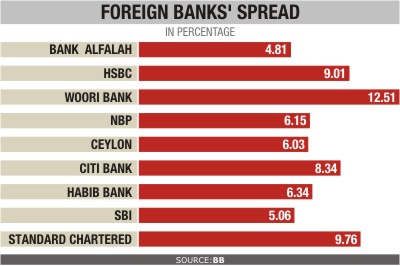
The central bank yesterday came down heavily on foreign banks having operations in Bangladesh for a high interest rate spread, which is depriving both depositors and borrowers.
Bangladesh Bank (BB) asked all commercial banks, including foreign banks, to keep the interest rate spread at 5 percent. The average interest rate spread for foreign banks is around 9 percent, which is below 6 percent for the local commercial banks.
The suggestion came at a meeting on implementation of the monetary policy, which was announced last month, at the central bank office in Dhaka with its Governor Atiur Rahman in the chair.
A participant in the meeting quoted Rahman as saying the BB will closely monitor the interest rate spread to keep it below 5 percent, except for small and medium enterprises and consumer loans.
Hassan Zaman, senior economic adviser to the governor, presented a keynote paper on the latest monetary policy and current economic situation.
Zaman said the BB will also ensure adequate liquidity for productive investment, according to the participant in the meeting who requested not to be named.
The spread refers to the difference between the interest rates for lending and deposit.
BB statistics showed the weighted average deposit rate of the foreign banks was 4.51 percent in November 2011, while the weighted average credit rate was 13.34 percent at the same time.
In case of private banks, the weighted average deposit rate was 8.53 percent in November 2011, while the weighted average lending rate was 13.87 percent, BB data showed.
On one hand, the foreign banks are paying less interest to the depositors and on the other, they are making huge profits from a high interest on loans, the BB official said.
The foreign banks have made substantial profits over the years, although they have a limited scale of operations in Dhaka and Chittagong alone.
In 2009, the foreign banks made a net profit of Tk 930 crore, which was Tk 915 crore in 2010, according to BB data.
After the meeting, Sitangshu Kumar Sur Chowdhury, deputy governor of the BB, told journalists, “We asked the commercial banks to discourage loan disbursement to non-productive sectors and encourage loans for the productive sectors.”
He also said one of the major objectives of the recently launched monetary policy is to bring down the inflation rate to a single digit.
He said the BB also called upon bankers not to discourage imports of basic commodities.
Mohammed Nurul Amin, chairman of the Association of Bankers Bangladesh (ABB), said he supports the central bank's move to discourage loan disbursement to non-productive sectors.
The latest monetary policy targets to cut credit growth to the private sector to 16 percent by June. It was around 20 percent in December.
Both the BB deputy governor and ABB chairman said bringing down credit growth for the private sector to 16 percent is enough to achieve the current fiscal year's economic growth target.
A few days ago, the ABB leaders set a self-imposed cap on deposit and credit rates at 12.5 and 15.5 percent, to discourage unhealthy competition in the banking system.
At yesterday's meeting, all bankers committed to following the self-imposed cap on deposit and lending rates, said Chowdhury, adding that the central bank did not intervene in this process.
In addition, the primary dealer banks are currently facing a liquidity crisis as they cannot cash the excess investment in bonds at around Tk 16,000 crore.
The Daily Star/Bangladesh/ 10th Feb 2012
Economic indicators improving: BB
Bangladesh Bank (BB) yesterday said the major economic indicators of the country have started improving while the government’s borrowing from the banking sector also marked a fall in recent times.
Top officials of the central bank came up with the observations during a meeting with the chief executives of the scheduled banks at the BB conference room.
Bangladesh Bank Governor Atiur Rahman presided over the meeting.
Emerging from the meeting, BB Deputy Governor SK Sur Chowdhury said the government's borrowing from the banking channel exceeded Tk 210 billion a few days ago, which now stands at Tk 160 billion.
Food inflation has also come down while an increased remittance inflow has been pushing the economic indicators upward, Shur Chowdhury said.
He also said the meeting discussed the ways to effectively implement the new monetary policy.
The meeting gave some directives to the banks to work on implementing the monetary policy as well as aiming to lowering down the inflation rate to a single digit, the BB deputy governor added.
The Daily Sun/Bangladesh/ 10th Feb 2012
NBL offers 65pc stock dividend for 2011
The board of directors of National Bank Limited (NBL) has recommended 65 per cent stock dividend for the year 2011.
The Company also reported earning per share (EPS) of Tk 7.07, net asset value (NAV) per share of Tk 25.02 and net operating cash flow per share (NOCFPS) of Tk 8.88 for the year.
The Bank will hold Annual General Meeting (AGM) on 19th of next month at Banghabandhu International Conference Centre (BICC) in the city. The record date for the entitled dividend has been set on 20th of the current month.
Rupali Insurance
Meanwhile, the board of directors of Rupali insurance has recommended 20 per cent stock dividend for the year 2011.
The Company has also reported EPS of Tk. 3.68, NAV per share of Tk. 37.95 and NOCFPS of Tk. 4.62 for the year.
The company will hold AGM on 5th of April at Sonargaon Hotel in the city. The record date for the dividend has been set 23rd of the current month.
The Daily Sun/Bangladesh/ 10th Feb 2012