


Citi appoints two Bangladeshis in global positions
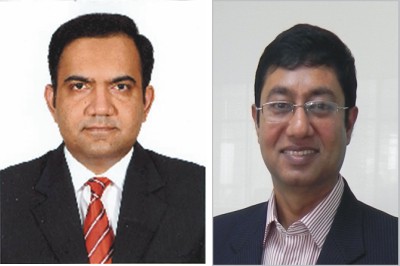 L-R: Parvez Murshed, Mir Hafiz
Citi Bank NA has recently appointed Parvez Murshed as its regional head of implementation for treasury and trade solutions (TTS) for Asia Pacific, and Mir Hafiz as head of trade services operations at Center of Excellence at Dalian in China.
Murshed is now responsible for the overall coordination and implementation for regional clients across Asia Pacific, the bank said in a statement yesterday.
He will be based out of Singapore. Prior to joining the regional role, Murshed headed the global transaction services business at Citi Bangladesh since 2008.
Hafiz will be responsible for managing trade operations growth and migration of trade into Dalian from across Asia Pacific region.
He will be part of the core TTS operations leadership team to ensure sustained growth in cash and account services operations in addition to trade in Dalian.
“Citi seeks out and hires diverse and highly-talented individuals; with business presence in more than 160 countries and jurisdictions, these talented individuals have a unique opportunity to build their professional career using Citi global network,” said Rashed Maqsood, Citi country officer.
The Daily Star/Bangladesh/ 27th Feb 2012
Govt raises savings tools’ rate of return from Mar 1
The government has raised the rates of return on all existing savings tools by as much as 2.64 per cent with effect from March 01 next to help lower the government's borrowing from the banking system, a senior official in the Ministry of Finance (MoF) said.
The Internal Resources Division (IRD) under the MoF on Thursday issued the circular to this effect. Finance Minister AMA Muhith approved the upward adjustment of rates of returns on different savings instruments on Wednesday last, sources said.
The rates of return on all five categories of saving instruments have been revised. These are -- 5-year Sanchayapatra, three-monthly Sanchayapatra, Pensioner Sanchayapatra, Poribar Sanchayapatra and Postal Savings Bank (fixed deposit).
However, the current practice about deduction of five per cent tax at source and the investment limit will remain unchanged. The current savings instrument holders, regardless of categories, will not get the facility of enhanced rate of return, a high official in the IRD said.
According to the circular of IRD, signed by its Secretary Dr. Nasir Uddin Ahmed, the rate return on five-year Sanchayapatra has been revised to 13.19 per cent including 0.99 per cent Social Security Premium(SSP) from existing 11.55 per cent.
The rates in case of getting returns before the expiry of five-year period for five-year Sanchayapatra have also been increased to a
level between 9.20 per cent and 11.45 per cent compared to the current rates ranging between 8.0 per cent and 10.25 per cent, the circular said.
The rate of return for three monthly Sanchayapatra (3-year) has been raised to 12.59 per cent from existing 10.78 per cent. The rates in case of getting returns before the expiry of three-year period for three monthly-return-giving Sanchayapatra have also been increased between 9.80 per cent and 10.80 per cent compared to the existing rates available from 8.40 per cent to 9.40 per cent.
A three-monthly Sanchayapatra holder will get Tk 3147.50 after the new rate of return comes into effect, which is now Tk 2695. The deduction of a five per cent tax at source is applicable in both cases, an IRD official said.
The rate of return for Pensioner Sanchayapatra has been revised to 13.19 per cent from existing 11.81 per cent. The new rate will be applicable after five-year maturity period, the circular said.
The rates in case of getting the return before the expiry of five-year period for Pensioner Sanchayapatra have also been increased to a level between 9.20 per cent and 11.45 per cent compared to the current rates ranging between 8.0per cent and 10.25 per cent, the circular further said.
The rate of return for Poribar Sanchayapatra has been raised to 13.45 per cent from current 12.07 per cent. The rates will be between 9.20 per cent and 11.45 per cent in case the encashment of the tool is made before the expiry of the five-year term.
The rate of return for Postal Savings Bank (fixed deposit) has been increased from current 11.08 per cent to 13.24 per cent, the circular said.
Officials in the MoF said following the adjustment of rates of return, the budgetary cost of the government will be increased significantly but its level of borrowing form the banking system will decline strikingly.
"We cannot afford a huge level of borrowings from the banking system by the government, target of which has already exceeded during the first four months of the current fiscal year," a MoF official told the FE on Saturday.
"The middle income groups in the society will be benefited by the latest decision of the government," he added.
Recently, the commercial banks have raised their interest rates on bank deposits and many small savers found it profitable to transfer their fund from savings tools to banks resulting in poor sale of such instruments, which are the main avenue for non-bank borrowings by the government.
The government fixed the net selling target of the savings certificates at Tk 60 billion for fiscal year (FY) 2011-2012. However, the sale during the first six months of the current fiscal year from savings certificates was, in value terms, only Tk 3.34 billion, according to the data of the government.
Presently, the highest limit of investment in savings instrument is Tk 3.0 million for a single individual and Tk 6.0 million under joint names. This limit is applicable for all available tools other than Poribar Sanchayapatra. The highest limit for Poribar Sanchayapatra is Tk 4.5 million.
"The existing limit of investment will remain unchanged," an IRD official said.
Financial Express/Bangladesh/ 26th Feb 2012
e-banking: internet security knowledge
In this age of technology, internet banking is quite a handy way to keep track of your finances. You simply log on through your bank's website, and you can do things like setting up standing orders, transferring money to people or other accounts, recharging your cell phones, and ordering cheque books etc. In a word, all the jobs that you would otherwise do going to a branch of a bank physically, can be done by logging on the website of your bank.
In the developed countries branch banking has already become obsolete. Though late, our banking industry is heading to this direction. Electronic banking also allows you to get financial deals that are just not on offer in the offline world. For convenience sake, you can't beat an online bank!
Among the domestic banks in Bangladesh, the private ones are ahead of their public sector counterparts in respect to going digital. AB Bank, Bank Asia, BRAC Bank, City Bank, Dhaka Bank, Dutch-Bangla Bank, Eastern Bank, First Security Bank, Islami Bank, Mercantile Bank, Mutual Trust Bank, NCC Bank, Prime bank, Premier Bank, Shahjalal Islami Bank, Southeast Bank, Standard Bank and Trust Bank are some of the banks marching towards e-banking. Some of them have full-fledged e-banking services but many are at primary level indeed. However, all are getting huge response from the customers and the remaining ones are expected by computer literate clients to launch internet banking.
The risk lies here as very few internet browsers have enough security awareness for surfing the internet. Earlier this issue of security was not much of a serious matter; the net users used to explore the sites without confronting any threat of loss but now it is all about money. So, security should be of the top-most priority. It is high time to use the internet, considering all the security measures.
However, the popularity of online banking has not gone unnoticed by the criminal gangs. The cyber criminals are also trying their best to fool your banker and you. One of the most common ways that a criminal will attempt to part you with your money is through something known as Phishing. Phishing is pronounced 'fish-ing'. The fisherman is a criminal, the bait is usually an e-mail that attempts to panic you into action, and the fish is you (the client)! Normally the criminal sends out thousands of e-mails using a list he got from a spammer.
The e-mail sent to you pretends to be from a real bank. Most people to whom the criminal sends the e-mails, will not have an account with that bank. But some will. It is those few that the criminal is after. In the e-mail, you may be warned that your banking details need updating, and it is essential that you act now to protect your account. They will usually try to scare you into taking action.
And there is always a link for you to click on. All you need to do is to click on the link and you will be taken to another area where you can enter your details. If you click on any of these links, you'll be taken to a page that does indeed look like your bank's website. In fact, it is not.
One trick the criminal may use is to have an address that looks similar to your bank's. For instance, the real website address of your bank is www.ibbl.com. Now take a closer look at this address, www.ibb1.com. The address has been spoofed. The "l" (letter l-el) is now "1" (numeric 1-one). But some spoofed addresses are quite difficult to spot, and even fool the more experienced surfers. You need to look for other clues in your browser.
One thing that all browsers will have is padlock icon. These are supposed to tell you that the site is using security measures. If you're using Internet Explorer 7, you'll see this to the right of the address bar. Click on the padlock and you'll see information about the security certificate. Click the link that says 'View Certificates'. Click the 'Details and Certification Path' tabs at the top. There should be plenty of details for you to view. Make sure the certificate has not expired.
The Firefox browser has more visual clues than Internet Explorer. Notice the address bar from Firefox. The address bar will turn yellow on a secure site, and the padlock is just to the left of the blue down arrow. Firefox also has another padlock. Look in, at the bottom left. Double click the padlocks and you'll see the security certificate. Notice the name of the website to the left of the padlock carefully.
One more thing is to be noted. The address for a secure site normally starts with https. If the "s" is missing, it's not a secure site! Every intelligent netizen must remember that your bank will never send you an e-mail asking for you to log in details! If you receive such an e-mail, forward it to your bank.
And don't click on the link! The same is true for other secure websites that hold your money - PayPal (coming soon in Bangladesh) never send you e-mails asking you to confirm your details! The latest versions of Firefox and Internet Explorer have anti-Phishing measures built in. You should make sure these are turned on when accessing secure websites. (In Internet Explorer 7, click Tools > Phishing Filter > Check this Website.)
Password may fail you if it is not wisely made and managed. In fact, we have all got lots of passwords! We've got so many that it has become increasingly difficult to keep track of them all. Banking passwords are no different. But the recommendation is to keep changing each one every few months or so!
Because, the whole password process is cumbersome, some people have one password for all of the sites on the internet that ask for them. This is something you should never do! You need a different password for each site. The reason is simple - if a criminal has your password for one website, he has got them for all your sites - he could clean you out!
The problem is, how do you remember them all? One technique for password creation is to take letters and numbers from a favourite song, saying, or something that's special to you. For example, a favourite saying of your own may be "only the uncertainty is certain in this world"! To turn this into a password, take the initial letters of each word. You'd then have this: 'otuicitw'. Let us complicate it a bit, by adding some capital letters: 'OtuicitW' slightly more secure. Let's add a number: '1OtuicitW10'.
Adding non alpha-numeric character helps password security enormously. '1_OtuicitQ_10'. Now, not only is the password longer, but also it has a mix of numbers, lowercase and uppercase letters, and non alpha-numeric character. This makes it more secure and harder for criminals to guess. A password like this is also easier for you to remember. Passwords should never be just four characters long! The reason is that criminals may have password-cracking software. Using such software, short passwords can be cracked in no time at all. Use at least eight characters.
Try not to log in to your bank account using somebody else's computer. Simply because you have no idea what security measures they take, and whether or not the computer is infected. Internet cafes are also not somewhere you should be entering security information.
In an internet cafe, all the data you enter are logged and saved by the owners. In some countries they are forced to do this by the state law. You can never be sure that your data are safe from prying eyes. Also, what if you forget to log out properly? The next person who uses the computer could see all of your details, and have access to your bank account!
The only place you should be entering your bank details are from your own personal computer (PC). Of course, you need to make sure that your own computer is safe from infection, and take sensible security measures when it comes to the e-mails you receive.
For ensuring safe internet banking basic computer literacy with security issues is a must. Any bank, being the custodian of the hard-earned money of the valued clients, should play a significant role in this regard. As an organisation a bank has enough scope to build awareness among its customers.
The banks can arrange internet learning programme for their existing and prospective e-banking clients, highlighting the security issues related to the transactions. Likewise, the customers should not depend only on the bank for safety. They should shoulder some responsibility, too, to learn the proper use of the internet for the sake of their own benefits. The combined efforts by the bankers and customers will be more effective to safeguard the banking transactions.
We need to remember the developed world is suffering a lot due to cyber crime - losing huge amounts of money digitally. So, if we don't look before we leap, we will be exploited digitally and once the security becomes alarming, the clients will be discouraged to go digital. Then the merits of e-banking will start turning into demerits and the growing e-banking movement may face a setback.
Who does not know that prevention is better than cure? Remember anything digital is not that it will be of hundred per cent perfect. The way you are served is changed, so is the way you are robbed. But what's wrong if we try to adopt more and more viable security measures with our intelligence? After all, this is the age of survival of the fittest!
Financial Express/Bangladesh/ 26th Feb 2012
Solid US candidate would be good as new WB chief : Zoellick
A solid U.S. candidate to head the World Bank would be good for the United States and the bank because the world’s largest economy should be represented in top international bodies, outgoing President Robert Zoellick said on Saturday, while emphasizing he has no role in the selection process.
In an interview in Singapore, Zoellick also said he did not believe Spain, Italy or Portugal needed bailouts to ease massive debt burdens but that reforms needed critical support of Germany and other European leading nations and expressed cautious optimism that the global economy would sustain growth this year.
The World Bank last week launched the nomination process to select a new president to succeed Zoellick when he steps down in June, inviting names from any of its 187 member countries. The Obama administration has said it would open the process to competition.
Zoellick noted however that Americans did not hold top posts at the United Nations, World Trade Organization, regional development banks or International Monetary Fund.
“I want the United States to feel a sense of responsibility to the international system. So in that sense if you get the right American candidate I think that can be good for the United States and the bank.”
So far, two people most often mentioned as possible successors are both American: U.S. Secretary of State Hillary Clinton and former White House economic adviser and former Treasury Secretary Lawrence Summers. The State Department has insisted that Clinton would not be taking the job.
Much like in 2011, when Dominique Strauss-Kahn resigned as managing director of the International Monetary Fund, officials from countries such as Brazil and the Philippines said it was time to break the decades-old pattern of putting an American in charge of the World Bank and a European atop the IMF.
Agustin Carstens, Mexico’s central bank governor, who had made an unsuccessful bid to head up the International Monetary fund last year, said on Wednesday the World Bank presidency should be open to a wide field of candidates.
Zoellick said the latest Greek bailout totaling 130 billion euros would merely buy time.
“It’s too early to know, partly it depends on the actions the Greeks have to take,” he said.
“I think that the European Union has dealt with Greece as one element but the core elements are really going to be the success of some of the bigger countries, such as Italy and Spain.”
But he said bailouts weren’t necessary for these two countries or Portugal.
“Each country’s situation is different and you really have three interconnected problems. For some it’s the size of the sovereign debt, for some it’s the effect on the banking industry, and for some it’s their competitiveness,” he said adding that “Spain and Italy need time to make the reforms.”
The Independent/Bangladesh/ 26th Feb 2012
Agrani Bank holds workshop on agri-loan
 Arajit Kumar Das, deputy general manager of Agrani Bank Rangpur Circle, addresses a day-long workshop in Gaibandha.
GAIBANDHA: Speakers at a function yesterday laid stress on easy access to agriculture loans for the farmers so that agro-production could achieve sustainable growth.
As the majority people of the country depends on agriculture for earning their livelihood, there was no choice other than developing the agriculture sector, they said.
They came up with the urge at the inaugural function of a day-long workshop on ‘Agro- financing and Recovery: Outreach in Gaibandha’.
Agrani Bank Training Institute (ABTI) organised the function at Zilla Parishad auditorium in the district town.
Arajit Kumar Das, Deputy General Manager (DGM) of Agrani Bank Limited for Rangpur Circle addressed the function as chief guest while Assistant General Manager (AGM) of rural credit division of the Bank Nezabat Ali and AGM plus faculty member of ABTI Sadhan Chandra Mondal, course coordinator and principal officer Jahangir.
The Daily Sun/Bangladesh/ 26th Feb 2012