


Premier Bank declares 22pc dividend
 Premier Bank Chairman Dr. H. B. M. Iqbal presides over the 13th Annual General Meeting (AGM) at Bangabandhu International Conference Centre in the city. Bank’s Vice Chairman B. H. Haroon, MP and other Members of the Board and Bank management are also seen
Premier Bank declared 22 percent stock dividend for the year 2011 at the 13th Annual General Meeting (AGM) of the Bank held at Bangabandhu International Conference Centre in the city on April 15. Dr. H. B. M. Iqbal, Chairman of the Board of Directors presided over the meeting.
Dr. Iqbal informed the shareholders that during the year 2011 the Bank earned net profit of Tk. 51.9 crore. Total deposit of the Bank rose by 10.97 percent over the last year to reach the total of Tk. 6069.30 crore.
Total loans and advances stood at Tk.4977.49 crore yielding a significant growth of 7.27 percent. After detailed review the shareholders approved the accounts and Directors Reports and dividend at the rate of 22 percent for 2011 in the form of bonus share.
The Chairman appreciated the support of the Board members and the effort made by the management team to bring about improvement in the operations of the Bank.
The shareholders thanked Dr. Iqbal for his contributions to the Bank.
Majedur Rahman, Managing Director, informed the shareholders about various steps being taken to improve efficiency and to introduce products and services. The Bank has already opened up a new horizon in the corporate world with the introduction of some sophisticated and technology-based products.
Among others Directors Moin Iqbal, Md. Imran Iqbal, Shah Md. Nahyan Haroon, Md. Masud Zaman, Md. Lutfur Rahman, Managing Director Majedur Rahman, Additional Managing Director Abu Haniff Khan and Bank’s Company Secretary Syed Ahsan Habib were also present on the occasion.
The Daily Sun/Bangladesh/ 18th April 2012
Pubali goes big in online banking
 Helal Ahmed Chowdhury, managing director of Pubali Bank, attends a press conference in the capital yesterday where he announced plans to launch the Bank's internet banking service today.
Pubali Bank has brought its 310 branches under online network and plans to bring the remaining 100 branches under the network in phases, the Bank said in a statement yesterday.
The Bank looks to establish its own ATM network with 1,000 ATM booths across the country and set up 100 such booths this year.
The Bank also plans to launch internet banking services using its own software today.
The announcement came at a press meet in the capital yesterday where the Bank's Managing Director Helal Ahmed Chowdhury and Additional Managing Director MA Halim Chowdhury were present.
Pubali Bank started its transition from the traditional manual banking operation to computerised banking services in 1991 with vendor provided software, according to the statement.
In 2004, the Bank started replacing the software with its in-house developed branch banking software, Pubali Integrated Banking System.
In 2008, the branch banking software was converted to core banking software which was evaluated by Price-waterhouseCoopers
Pvt Ltd, India, and the Bank computerised all its branches with the software.
On the same year, the Bank started launching online banking system at its selected branches.
The Daily Star/Bangladesh/ 18th April 2012
Asian economies to weather global storms: IMF
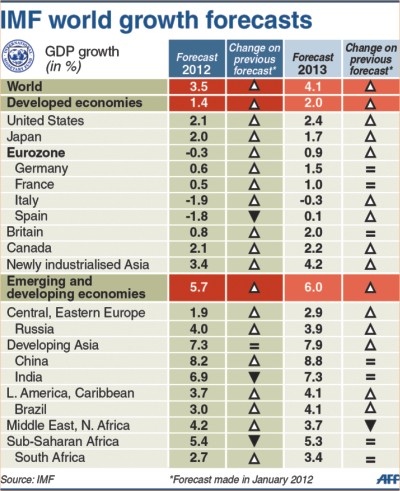 The International Monetary Fund yesterday raised its global growth forecast, with the US boosting the outlook but Asian emerging economies facing slower economic expansion.
The world economy will expand 3.5 percent this year and 4.1 percent in 2013, the IMF said in its April 2012 World Economic Outlook yesterday ahead of the Spring Meetings of the IMF and the World Bank in Washington.
Prospects for the global economy are slowly improving again, but growth is expected to be weak, especially in Europe, and unemployment in many advanced economies will stay high, according to the IMF's latest forecast.
“For the past six months we've been on a rollercoaster ride,” said IMF Chief Economist Olivier Blanchard. “Our baseline is that growth is going to be slow in advanced economies; sustained, but not great, in emerging market and developing economies. But the risk of things turning bad again in Europe is high.”
US economic growth is projected at 2.1 percent in 2012 and 2.5 percent next year, reflecting ongoing fiscal consolidation and continued weakness in housing prices.
On Asia, the report said, weaker external demand has dimmed the outlook for Asia. But resilient domestic demand in China, limited financial spillovers, room for policy easing, and the capacity of Asian banks to step in as European banks de-leverage suggest that the soft landing under way is likely to continue.
Overall, growth in Asia will average 6.0 percent, with China slowing to 8.2 percent and India to 6.9 percent.
The region's emerging economies suffered spillover effects in 2011 from the euro zone crisis, which hit exports to Europe and also pinched trade credit and project finance as European banks were forced to retrench, the report said.
An escalation of the Eurozone crisis could lower emerging Asia's output by 1.25 percent, said the IMF, which also warned of the risks of an oil price spike from tensions in the Middle East.
"The fragility of the external outlook highlights the need for the region to rebalance growth by strengthening domestic sources of demand over the coming years," it said.
The report said many Asian economies could also advance their plans to boost social safety nets and increase investment in infrastructure if another round of fiscal stimulus is warranted.
Another flare-up of the Eurozone sovereign debt crisis or sharp escalation in oil prices on geopolitical uncertainty could easily undermine confidence and disrupt the improving growth path for world economy, the IMF said.
"With the passing of the crisis and some good news about economy, some optimism has returned. It should remain tempered," said Blanchard.
"Even absent another European crisis, most advanced economies still face major brakes on growth. And the risk of another crisis is still very much present and could well affect both advanced and emerging economies," he said.
The IMF said the most immediate concern is still that further escalation of the euro-area crisis would trigger a much more generalised flight from risk. “Geopolitical uncertainty could trigger a sharp increase in oil prices.”
A 50 percent increase in the cost of oil would reduce global output by 1.25 percent, according to the report.
The report said that governments should strengthen policies to solidify the weak recovery and contain potential risks that can weigh on consumer and investor confidence.
Advanced economies should implement medium-term budgetary savings, but not in a way that could undermine the recovery. In developing countries and emerging markets, policies should be geared toward ensuring a soft landing for economies that have seen sustained, very strong credit growth, it said.
The IMF also said Asian nations face elevated price pressures that will constrain monetary easing even as the growth outlook for the region dims.
“Although monetary tightening has been appropriately paused in many Asian economies, and cautiously reversed in some, room for further easing is constrained in economies where underlying inflation pressures remain,” it said.
The Daily Star/Bangladesh/ 18th April 2012
17th anniversary of Prime Bank Vow to carry banking services to un-banked people
 Shirajul Islam Mollah
Special Correspondent
Prime Bank Ltd will grow further to consolidate its presence in the development of the country's economy.
"We will turn 17 today (Tuesday) and our presence will be further expanded in near future," Md Shirajul Islam Mollah, chairman of Prime Bank Ltd told The FE in an interview recently.
Prime Bank started its business from 17th April, 1995. Mr Mollah spoke about the bank's successes, current activities and future plans to the FE on this occasion.
"17 years, is not a long duration for an organization as opposed to a person. Prime Bank has achieved quite a significant success in this short span of time. It is a leading commercial bank in the country at this moment," he said.
Mentioning the pioneering role of the Bank in recent years, he said Prime Bank first launched the consumer credit schemes to raise the purchase power of the customers. Under this, customers get the advantage of purchasing Television, Refrigerator, Computer, Car, etc. through Bank loans and pay back at Equal Monthly Installments (EMI).
"Today, you can find this scheme in every banks," he added.
"The Prime Bank also started Islamic Banking simultaneously. The accounts of the Islamic Banking business are maintained according to the Islami Shariah separately from the conventional banking business. Today, you can see a lot of Banks having Islamic Banking along with their conventional banking system."
He said Prime Bank is the first choice of people of the grass-root level of the country. The Bank's products and services are created considering the needs of the people.
The chairman also vowed to bring country's un-banked population under inclusive banking services through different innovative and technology-based products in the coming days.
The chairman said the Bank got permission to open new 12 branches this year, which will raise the total number of branches at 131. The new branches will be set up following 1:1 ratio (one in city and another one in outside Pourashava) to spread the banking services in the rural areas, he said.
He put light on the Bank's business successes, at home and aboard, including achievements of awards like SAFA, ICAB as the best bank. The bank grabbed the credit rating by CRISL to ST-1 in the short term and AA+ in the long term, he added.
The chairman said the Bank took many kinds of steps to increase the remittance flow and various SME loans to make the national economy stronger.
Prime Bank introduced internet and mobile banking this year to ensure a wide and maximum use of information technology, and launched school banking "My First Account" for the school going students, he said.
This month, the bank is going to launch two new products-- Platinum Card and Biometric Smart Card (Prime Cash)-- this month, he disclosed.
The Bank is also rendering different short and long term philanthropic services in the health and education sectors for the people's welfare through the Prime Bank Foundation.
The foundation's services include financial support to the poor and meritorious students for their higher education, establishment of an international eye hospital at Dhanmondi in the city, he said, adding that the bank has a plan to set up a medical college and nursing institute at Ashulia.
As per of its support to the country's sports, the Bank has already acquired ownership rights of Old DOHS Cricket Club, which will be known as 'Prime Bank Cricket Club". The Bank will also establish a cricket academy based on this club to train up the upcoming talented cricketers, Mr Mollah said.
Financial Express/Bangladesh/ 17th April 2012
Interbank Islamic money market: How far?
One fine morning, at the end of 2011, I was overwhelmed with joy, being also grateful to the central bank as well as seven Islamic banks of the country. That was a piece of exciting news for the country's Islamic banking industry. Seven full-fledged Islamic banks and 15 dual or mixed banks, alongwith two shariah-based non-bank financial institutions, were delighted to get a solution to one of their long-felt problems.
We are mentioning here the decision about the formation of an inter-bank Islamic money market. The entire nation came to know that inter-bank Islamic money market, for the first time in Bangladesh, sailed its voyage, with effect from the last working day of the year, 2011.
National dailies published the news with due importance. This created a vibration in the economy of the country. That was a ray of great hope and aspirations, amid the cloudy days of deposit-crunch in the overall banking industry of the country. For Islamic banking, the news of the Islamic money market was, as if it were, the golden deer in their hands. It was the implementation of a dream that the industry has earnestly been cherishing for long -- for more than a couple of decades.
So my joy knew no bounds. There were bitter experiences before that, because of non-existence of an inter-bank Islamic money market. The long-awaited market was finally the outcome of a meeting of the chief executive officers and managing directors of seven Islamic banks with the Bangladesh Bank that was held on December 21, 2011. One member of Shariah Boards from each bank was present at that meeting. The outcome of that meeting was considered a milestone in the history of the Islamic banking in Bangladesh.
Whenever we look at the balance sheet of any bank, we observe that banks, by their very nature, combine short-term liabilities with long-term assets. This results at times in maturity mismatches. The banks try to minimise the potential risks resulting from such mismatches through their prudent liquidity management. This prudence is applied by the fund managers, typically through inter-bank money markets.
Since conventional inter-bank markets are interest-based ones, Islamic banks cannot participate therein. Therefore, to manage their liquidity positions, an alternative market design has for long been felt to be essential. In other words, an inter-bank Islamic money market -- certainly free from interest - has, therefore, been considered a dire need since long.
Due to absence of an inter-bank Islamic money market, Islamic banks and Islamic units of dual operators have, for a number of years, operated with no access to tradable short-term treasury instruments. As a result, they could not channelise their excess funds to the market.
This scenario obstructed some of their growth potential by forcing them to hold substantial cash, losing expected earning therefrom. Trade-offs between profitability and liquidity could not be matched well. On the other hand, in time of any deficit, the Islamic banking units particularly of conventional banks, because of their hybrid nature, used to face a greater dilemma.
As liquidity is the blood of a bank, the shortage thereof might affect any bank extremely. The conventional banks, in such extreme cases, can meet the situation only by taking recourse to high cost fund. This is because they can offer a fixed high rate interest to the depositors or fund-providers during any crisis.
But an Islamic bank cannot do so in such a manner because such a fixed rate, be it low or high, on their deposit, tantamounts to offering interest. But Islamic banking as an alternative discipline is meant for, and born for, shunning the path of interest-based operations.
Interest is unconditionally forbidden under the Islamic jurisprudence, having a direct reference to the teachings of the Quran. But such a crisis can also compel many Islamic units to indulge in, what can be formed from an Islamic point of view doubtful deals. The suggestion of Bangladesh Bank to open Mudaraba SND Accounts with each other among the Islamic banking operators, did not appear to be a proper and adequate alternative to inter-bank Islamic money market.
In the backdrop of the scenario noted above, the official circular, dated December 27, 2011, came directly from the Bangladesh Bank that was addressed to the Chief Executive Officers (CEOs) of the scheduled banks and financial institutions.
The message was clear: It was decided by then to commence an Islami inter-bank fund market (IIFM) for achieving excellence and ensuring solidarity in the matter of liquidity management of all the Shariah-based banking and leasing operators, as was already stated earlier. They would participate in the market under certain rules which, among other things, contained that:
All the parties concerned might place their respective surplus money with the Islami Bond Fund (IBF) on a daily basis. Islami Bond Fund (represented by Bangladesh Bank) would collect the fund as the custodian and provide the deficit units with fund therefrom.
Transactions would be made on Mudaraba -- a profit, sharing partnership -- basis and the profit would be distributed to the fund-providers, according to the profit sharing ratio (PSR), as determined by the IBF and agreed upon by the concerned parties. All concerned rules and regulations, as designed by the IBF, were to be adhered to, and so on.
With an earnest eagerness for participating in the Islamic money market since 'day one' of its operation and to register the name of our Bank with historic day of the nation for its Islamic banking industry, we started waiting. Time was passing; days, weeks and then months.
Then I recalled the days of my student life while studying 'market' in Economics. In Economics, market does not necessarily mean a specified place. It rather means any rendezvous of buyers and sellers -- the most essential elements alongwith the goods to deal (in).
This era of digitalization and automation has made it more practical the market players not to have any definite place or location for their transactions to take place. Luckily, the said fund market arrangement also appointed a custodian for their voluntary service. It is the regulator itself, the central bank -- Bangladesh Bank -- who will act like an escrow account-operator. It is a very good arrangement and, thus, a piece of very heartening news.
But alas! Not a single paisa's transaction appears not to have taken place in that long-awaited market until now. Why? We cannot but recall here the very common story. The gunman could not open fire because of a lot of reasons. None needs to wait to hear a series of reasons for his not opening the fire, as the non-availability of ammunition is narrated. We apprehend the similar incidence here. Money market sans money!
We cannot believe that for more than three months, there was not a single occasion when, at least, any of the aforesaid banks did not have the capacity to pour money into the market. A market must have something that attracts both buyers and sellers.
Only buyers are not at all sufficient to build a market. No single transaction taking place in the said market seems somewhat comparable to buying a cell phone's SIM against which only a single number has been provided but that site has yet not been activated. Activation is a must to make a cell phone usable. Interbank Islamic money market also needs an activation. But this is not possible without money.
As such, we would like to urge upon the regulator -- Bangladesh Bank -- as well as the giants in the Islamic banking industry who can, by themselves, bell the cat or can make it to do so. The question is very simple. There is no denying that there is demand for money during the period mentioned here. The supply has been the factor of consequence here. Someone must play the role of being the first supplier of money. This is a must to make it possible for the market to enter its operational phase.
We fear that there are some limitations on, or weaknesses about, the structure of the market. That might have kept the potential supplier of money away from it. If that is so, it should be properly looked into. The problem should be addressed, so that surplus units get confidence to play their role in the market. There must not be any reason for them to keep fund rather idle than putting in the same in the market. The modus operandi of an inter-bank Islamic money market should be well-structured; efforts here need to be accompanied by an assurance about strict supervision by Bangladesh Bank so that none can play any foul game. That may allure fund to the market.
As the formation of the market has been announced by the central bank, we would like to see it functional in a win-win situation for all concerned so that it can become operational at the earliest opportunity. Above all, it should be considered to be the saviour in the event of any liquidity crisis among the Islamic banking operators. To bell the cat in this case may even be treated as an ongoing charity (Sadqa e Zaria) as the pioneer, leading to create followers of an well-purported initiative. We must not miss the golden deer that we have otherwise been awarded with.
The operation of this market will conform to the ethical principles of the value-based Islamic banking industry and promote the interests of all those concerned, who want to see the growth of this industry, both religiously and professionally. The crisis is the right time to test our values.
As already stated, we are afraid; the absence of this market may push some Islamic banking units towards violation of Islamic norms for the sake of their employment. In today's market, every big fish asks for a pre-fixed rate of return which is not commensurate with the Mudaraba mode, the profit-bearing deposit accounts (A/Cs) of Islamic banks.
So the Islamic bankers are either coming back with an empty purse or are indulging in interest-bearing deals, deceiving themselves. The infringement on the part of a foul driver is usually shifted onto the car's brand. Any wrong step by us will defame the ideology.
The writer is the Vice President and Head of Islamic Banking of Bank Asia Limited. The opinions expressed here are those of the writer, not necessarily of the organisation he is serving.
Financial Express/Bangladesh/ 17th April 2012