


Mercantile marks 13th anniversary
 Abdul Jalil, Chairman of Mercantile Bank, speaks at a press conference to mark the 13th anniversary of the Bank in Dhaka Friday.
Mercantile Bank Ltd pledged to focus more on new technologies, small and medium enterprises (SMEs) and mobile banking in the days to come to meet new banking demands, officials of the Bank said at a press conference to mark its 13th anniversary.
The Bank would also open new branches in remote parts of the country, AKM Shahidul Haque, managing director of the Bank,
said at the press briefing in Dhaka yesterday.
“Our major focus will be introducing new banking technologies in the new year. We also like to expand our SME and mobile banking services,” he said.
Established on June 2, 1999, the third generation private commercial bank enters into its 14th year of operation today (June 2, 2012).
“We’ve been contributing to our national economic development for last 13 years,” said Abdul Jalil, chairman of the Bank.
At the very outset, directors of the Bank had pledged not to involve the Bank with their own banking activities, later replicated by Bangladesh Bank, bringing successes to the Bank, said Jalil, also a ruling party lawmaker.
“We had also promised not to carry coals to Newcastle, and not to concentrate only on profit multiplying, resulting in its success,” he continued.
Jalim said in the coming days the Bank would also gear up its corporate social responsibilities, especially in the areas of healthcare and education.
He also pointed out few of the activities of the Mercantile Bank Foundation, the social work wing of the Bank.
He also informed media about the bank’s future plan of setting up charitable hospitals and kidney dialysis centres across the country. He added that the Bank would distribute Tk 10 million among impoverished students as scholarships next year.
As part of its 13th anniversary programmes, Mercantile Bank Foundation will also honour 13 noted personalities and an organisation of the country to recognise their contributions towards society, officials said.
The Mercantile Bank Achievement Award 2012 goes to Prof Abdul Mannan in education, Prof Harun Ur Rashid in medical, Aly Zaker in culture, Lt. Col. (Retd) Abu Osman Chowdhury in freedom fighter category, Hasan Hafizur Rahman (Posthumous) for research on liberation war, Prof Mosharof Hossain for economics and related research, poet Belal Chowdhury in Bangla language and literature, Abdur Rouf Chowdhury in industry and trade, Towab Khan in journalism, Shakib Al Hassan in sports, Haripad Kapali for agricultural research and development, BRAC founder Sir Fazle Hasan Abed for social infrastructure, Ibrahim Khaled in banking while the only organisation is Bangabandhu Museum.
The Daily Sun/Bangladesh/ 2nd June 2012
IBBL hold orientation course
 Abu Taher Mohammad Saleh, Deputy Managing Director of IBBL, seen with the newly-recruited female probationary officers at the Islami Bank Training institute in Dhaka. Q
Islami Bank Bangladesh Limited organized a orientation programme for its newly-appointed female probationary officers in Dhaka.
Islami Bank Training and Research Institute organised the orientation programme, said a press release Wednesday.
Forty one newly-recruited female probationary officers participated in the programme.
Eng. Mustafa Anwar, Vice Chairman, Eng. Md. Eskander Ali Khan, Chairman, Executive Committee, Md. Shahidul Islam, Chairman Audit Committee Md. Habibur Rahman, Syed Abdullah Mohammad Saleh, Deputy Managing Directors, Abu Taher Mohammad Saleh, Abdus Sadeque Bhuiyan, Executive Vice Presidents of Islami Bank Bangladesh Limited were attended.
Earlier another 96 female officers joined Islami Bank Bangladesh Limited. Mentionable that some female officers has been working the Bank from bottom to executive level, the release added.
The Daily Sun/ Bangladesh/ 31- May-2012
Social safety net may shrink in next fiscalAllocations down 6pc to Tk 226b
The government allocations for the social safety net programmes (SSNPs), a vital instrument to reach out the hardcore poor, may go down in the proposed budget for the next fiscal year in terms of the budget and the GDP.
As per a Finance Division draft proposal, the government may allocate Tk 212.40 billon to run the SSNPs in the 2012-13 fiscal year, which is 5.83 percent short of Tk 225.56 billion for the outgoing fiscal.
The proposed SSNP allocations would be 11.18 percent of the proposed Tk 1.90 trillion outlay for the next fiscal and 2.04 percent of the GDP, as per the draft paper of the upcoming budget.
The current fiscal’s Tk 225.56 billion SSNP allocations constitute 13.79 percent of the national budget and 2.51 percent of the GDP.
Meanwhile, Prime Minister Sheikh Hasina approved a SSNP proposal of the Finance Division on May 13.
Ensuring social security of the poor and empowering them through employment generation are at the heart of all of the government’s poverty reduction agenda, Finance Minister AMA Muhith said at a recently cabinet meeting on SSNP.
In the meeting he also said the number of the poor lactating mothers as well as widowed, divorced and distressed women beneficiaries will be increased under the SSNPs from next fiscal. But SSNP allocation doesn’t show any sign of raising the number of beneficiaries.
According to the draft paper, of the total SSNP outlay, Tk 173.33 billion will be allocated for SSN programmes while the rest Tk 39.07 billion will be allocated under social empowerment programmes like student stipend and microcredit.
The number of SSNP beneficiaries will increase to 4-4.5 million from next fiscal, draft paper said adding, a fresh survey on beneficiaries will be conducted from next year.
In April this year the International Monetary Fund Mission Chief (Bangladesh and Asia and Pacific Department) David Cowen has urged the government to handle its subsidy burdens carefully and to use subsidy money under SSNPs.
He went further by saying that the government should increase resources for a number of SSNPs as some of them were very effective in poverty reduction.
Dr. Ananya Raihan, executive director of D –Net, told daily sun that high inflation rates, which have hovered above 10 per cent for last couple of years, have definitely caused income erosion poor section of people. So SSNPs are essential to ease that problem, he added.
If the government would not increase SSNP allocations in next budget,it may become politically unwise for it in the long run, he added
Major SSNPs of the government are old age allowance, rural maintenance programme, vulnerable group development (VGD), vulnerable group feeding (VGF), employment generation programme for the hardcore poor, freedom fighters’ allowance, gratuitous relief, allowance for the financially insolvent disabled, open market sale (OMS), test relief and food for work programme.
The Daily Sun/ Bangladesh/ 31- May-2012
BB warns banks against rising classified loans
The central bank yesterday warned 16 banks against a rise in their classified loans in recent months and asked them to bring down the amount immediately.
The instruction came at a meeting between the Bangladesh Bank (BB) and the Association of Bankers Bangladesh (ABB), a forum of chief executive officers of banks. Governor Dr Atiur Rahman chaired the meeting.
The average rate of classified loans of the country's banking industry is 6.57 percent, but the rate is much higher at some banks.
This type of loan has a high rate of borrower default, and raises the cost of borrowing money for the other customers, according to Investopedia.
“The governor also asked these banks to reduce credit growth, which is on the rise, and to control the advance-deposit ratio in line with the monetary policy stance,” said the managing director of a private commercial bank who was present at the meeting.
The BB found the private sector credit growth increased to 19 percent now from 16 percent last month.
The governor also asked all commercial banks to settle accepted bills between them as per agreements.
Rahman said, recently a bank complained to the BB that four banks (accepting banks of bills) are not paying it the bills.
“We have cut the amount from those four banks and deposited it to the complainant bank,” the governor said in a statement.
Similarly, some other banks made such complaints and six banks have been given 10 days of time to settle those payments, said Rahman.
By accepting the bill or draft, a bank agrees to pay the face value of the obligation if the issuer bank (the drawer of the draft) fails to pay. By lending its name to the transaction, the accepting bank makes it easier for an importer or exporter to obtain trade financing. A bank, once it has accepted a draft, can either hold the paper until maturity or sell it in the money market.
The accepting bank assumes some risk, although in most cases the credit risk is minimal as banks generally deal only with tolerated companies. Maturities on accepted drafts generally range from 30 to 180 days; payment is due at maturity, which usually coincides with delivery of goods to the buyer.
Recently, settlement of accepted bills has been getting delayed by many banks, according to BB officials who are getting a lot of complaints about the issue.
“I welcome the BB move. It would help repatriate money from abroad faster,” said Anis A Khan, managing director of Mutual Trust Bank.
Khan said a committee comprising the bankers was formed several years ago to deal with the issue.
The meeting also discussed interest rates for deposits and lending, anti-money laundering issue and the growing pressure on the primary dealer banks.
The governor asked the CEOs to keep their promises they have made recently on the rates.
The ABB has set the maximum deposit rate at 12.5 percent and lending rate at 15.5 percent in the wake of a rapid rise in the rates after the BB withdrew its cap at the end of last year.
The Daily Star/ Bangladesh/ 31- May-2012
MFIs must have succession plans Say Muhith, Abed and Kholiquzzaman
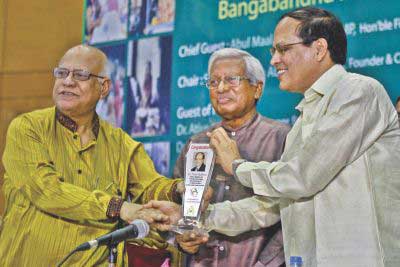 Finance Minister AMA Muhith gives a crest to Bangladesh Bank Governor Atiur Rahman on behalf of Credit and Development Forum at a conference on microfinance at Bangabandhu International Conference Centre in Dhaka yesterday. Sir Fazle Hasan Abed, chairperson of BRAC, is also seen.
Microfinance institutions (MFIs) should not be dependent on an individual to function properly. These should rather create strong institutional structures and succession plans to carry out activities without their founders or leaders.
AMA Muhith, finance minister, Sir Fazle Hasan Abed, founder and chairperson of one of the largest microfinance institutions BRAC, and Qazi Kholiquzzaman Ahmad, chairman of Palli Karma-Sahayak Foundation (PKSF), shared this opinion at a national conference on microfinance yesterday.
Institutional structures should be such that organisations will run well in future even without their founders or initiators, said Muhith at the inauguration of the event.
Credit and Development Forum (CDF), a network on microfinance, organised the programme chaired by Sir Abed of BRAC, world's largest development organisation.
Bangladesh Bank Governor Atiur Rahman also spoke.
Muhith's remark came after PKSF Chairman Ahmad stressed the need for making succession plan of organisations, especially the MFIs.
Abed echoed Muhith and Ahmad, saying that initiatives should be taken to ensure institutionalisation and improve governance of the MFIs.
Institutionalisation will facilitate the MFIs to improve governance and help them come out of the limitations of depending on individuals, said Abed.
The call comes as some quarters doubt over well functioning and the future of Grameen Bank without its founder Nobel laureate Prof Muhammad Yunus. The government removed microfinance campaigner Dr Yunus from the post of managing director of Grameen Bank in March last year.
Muhith said there are cases that organisations could not function properly and carry out their activities after the departure of their initiators.
"It is a curse. We should come out of this circle," he told the gathering of hundreds of microfinance practitioners from the grassroot level at Bangabandhu International Conference Centre.
Muhith's remark came as hundreds of MFIs carry out lending activities for low-income people all over Bangladesh, dubbed as the birthplace of microloans in the world.
Over the past three to four decades, the volume of microloans soared and helped many people come out of poverty and empower women. It has also played a role in mobilising domestic savings.
Currently, two crore families are the clients of microfinance and so far Tk 270,000 crore in loans has been disbursed to these families. At present, these households have Tk 40,000 crore in loans, said CDF Chairman Md Mosharraf Hossain.
Muhith said microfinance is one of the strong tools to reduce poverty. "But sometimes we wrongly term it as the only tool," said the minister, who was also upbeat about the poor borrowers.
"The poor are better borrowers than the rich. They repay loans. They are not like rich men who gobble up funds," he said, adding that default rate of microfinance is only 2-3 percent.
But the percentage of default loans stands at 6-22 percent at conventional banks from where rich people borrow, he said.
"We are proud of the microfinance borrowers," said Muhith, adding that microloan receivers would get loans at 27 percent interest including charges, fixed by Microcredit Regulatory Authority, the regulator.
The minister, however, suggested the MFIs should avoid overlapping and cross-funding. The regulator should take initiative in this regard, he said.
Sir Abed said microfinance has expanded much. But more tasks remain to be done, he said, citing the need to expand micro insurance and pension schemes for the poor.
Abed also wanted the regulator to create mechanism such as a Credit Information Bureau (CIB) of Bangladesh Bank so that the MFIs get credit info of borrowers and avoid lending to the defaulters.
He also demanded the government give permission to set up microcredit banks.
"Time has come for it and there is a need for it. We expect that the government will consider the matter seriously. There are microcredit banks in other countries. It is not clear why such banks will not be set up in Bangladesh," said Abed.
PKSF Chairman Ahmad also backed the idea of establishing microcredit banks.
The Daily Star/ Bangladesh/ 31- May-2012