


Balance-of-payment deficit easesShortfall comes down to $106m in April from $419m in March
Lower trade deficit, restricted imports and higher foreign aid have underpinned an improvement in the country's balance of payments (BOP) situation at the end of April of the outgoing financial year.
Bangladesh Bank (BB) data shows the BoP shortfall came down to $106 million in April this year, from $ 419 million in March. In the July-April period of the previous fiscal, the deficit in BoP was as high as $502 million.
A BB high official said the BoP situation has been improved due to lower trade deficit as a result of tightening monetary policy, which also restricted imports and encouraged exports to new destinations and pursued for accelerating the remittance mobilisation.
“BB was serious in executing the monetary policy stance (MPS) and monitored banks regularly, especially on opening of letters of credit (LCs), since the MPS for January-June of the current FY came to force early 2012,” said the official, seeking anonymity.
The country also received around $1.5 billion as foreign loans including $ 300 million from the International Monetary Fund (IMF) that helps ease the pressures in balance of payments, he said.
The official said the merchandise imports in the first half of the current fiscal saw a significant growth that led the central bank to intervene into restricting import of non-productive items so that no abnormal burden could rise with regards to BoP.
Due to the high demand for petroleum products for the fuel-run quick-rental and rental power plants, the country’s import expenditure stood at $ 28.8 billion at the end of May since July 2011, up 11.82 percent compared to the same period of the previous fiscal, according to BB statistics.
Opening of LCs for import of food grains (rice and wheat), capital machinery, industrial raw materials and other products together declined by 6.97 percent this fiscal compared to the previous fiscal.
For food grains, the fall in imports was 70.10 percent while capital machinery 25.82 percent, industrial raw materials 8.05 percent and others imports saw a fall by 4.41 percent in July-April period of the 2011-12 fiscal.
On the other hand, earnings from merchandise exports rose to
$ 21.7 billion in the July-May period of the outgoing fiscal. The growth in exports over the corresponding period was recorded only 8.2 percent. The growth was almost half than the strategic target of 15 percent for FY 2011-12, according to data available from Export Promotion Bureau (EPB).
Meanwhile, the country received a total of $ 11.7 billion in remittance during the July-May period. The country received another $580 million as foreign direct investment during the same period.
The Daily Sun/Bangladesh/ 23th June 2012
Oil prices up in Asia
SINGAPORE: Oil prices inched up in Asian trade today as wary traders bought up cheap crude to recoup some of their losses after the previous day’s plunge, analysts said.
New York’s main contract, light sweet crude for delivery in August, gained 33 cents to $78.53 a barrel in the afternoon, up from $78.20 in New York, its lowest level since the beginning of October.
Brent North Sea crude for August delivery advanced 65 cents to $89.88 after tumbling to $89.23 in late Thursday trade, dipping below the $90 line for the first time since December 2010.
“We’re seeing a small bounce for now. There is potential for a little bit of short-covering given the big moves last night,” Jason Hughes, head of premium client management at IG Markets Singapore, told AFP.
But he said the market outlook remained grim following disappointing numbers from China and Europe.
Preliminary data from banking giant HSBC on Thursday showed China’s manufacturing activity hit a seven-month low in June, while a separate survey showed eurozone private sector activity sank to the lowest level for three years in the second quarter.
The Daily Sun/Bangladesh/ 23th June 2012
Rental power benefits vested groups
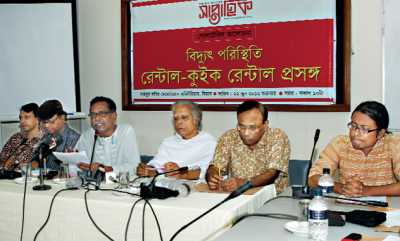 Prof Dr Anu Muhammad speaks at a roundtable in Dhaka Friday.
The government is continuing power generation through rental power plants to help maximise profits of a section of people, despite having its huge negative consequence, speakers said yesterday.
Instead of running the quick rentals, the government could generate 1,600 megawatt more power through renovating the run-down power stations in last three years, they told a roundtable.
Weekly magazine ‘Shaptahik’ organised the roundtable in Dhaka, attended by civil society members and energy experts.
The speakers also suggested that the government should prioritise gas-based and state-owned power plants for low-cost power generation. A nexus of bureaucrats, professionals and politicians is cashing in from the acute power crisis and creating money through rental powers.
They pointed out that supplying gas to private stations, depriving the low-cost state ones, is a part of that blueprint.
“The retention of power crisis along with continuing rental powers is a clear indication of making country’s utility sectors profit-making ventures for the private sector,” Prof Dr Anu Muhammad, who teaches Economics at Jahangirnagar University, said.
“The repeated power rate hikes and setting Tk 13 to Tk 19 per unit price for uninterrupted power are parts of the roadmap of that conspiracy,” he continued.
He said price hike has not been done for improving the power situation, but to compensate the mistakes of the government in the sector and benefit a handful of opportunists.
Dr MM Akash, professor of Economics at Dhaka University, said the government initially went for the emergency solution to offset huge power crisis it inherited from the previous government.
“But, actually it was a wrong decision and created a hotchpotch in the whole economy,” said Akash.
Dr Anu Muhammad said the government could easily make 2,400MW of power only spending Tk 12-15 billion by improving the efficiency of the existing plants. On the contrary, it spent nearly Tk 320 billion to generate 900MW from rental or quick rental powers, he said.
The government is cutting subsidies being prescribed by the International Monetary Fund; but not the causes behind the subsidies. He said subsidies are given to ensure health, education, and small entrepreneurship for common people. But now these are going to give business to a vested quarter.
He said IMF uses its loans as an instrument to create a platform for private sector or multinational companies.
Taking part at the discussion, Syed Abul Moksud said people are now becoming intolerant about the power crisis, which has been made artificially.
He called for forming a highly-powered citizen committee to investigate irregularities taking place in the rental powers.
The Daily Sun/Bangladesh/ 23th June 2012
Janata Bank opens branch in N’ganj
 SM Aminur Rahman, Managing Director and CEO of Janata Banlk Limited, inaugurates a branch of the bank at Katpotti Bazar in Narayanganj.
The state-owned Janata Bank Limited opened its 881th branch at Katpotti Bazar in Narayanganj.
SM Aminur Rahman, Managing Director and CEO of Janata Banlk Limited inaugurated the branch, said a press release Friday.
Dr. Salina Hayat Ivy, Mayor of Narayangonj City Corporation attended the inaugural ceremony as chief guest.
Md Abdullah Al Kaisar, MP, Md Dabir Uddin Ahmed and Dr. RM Debnath, directors of the bank, S M Aminur Rahman, CEO and Managing Director, Md. Abdus Salam, DMD, Md. Mohsin Mia GM, Divisional Office, Dhaka South were also present.
The Daily Sun/Bangladesh/ 23th June 2012
Banking Division utilises 19pc ADP this FYMinistry asks for speeding up spending
The planning ministry has identified severe inefficieniesy in implementation of annual development programme (ADP) by the Banking Division of the Finance Ministry in 2011-12 fiscal and asked the authorities concerned to accelerate the execution process as much as possible by the end of the outgoing fiscal.
In a letter sent to Banking Division Secretary Safiqur Rahman Patwary on June 13, the Implementation, Monitoring and Evaluation Division (IMED) of the Planning Ministry also advised the concerned ministry’s head to cancel the holidays of all concerned officials and employees in order to achieve higher progress in ADP implementation.
The Planning Ministry letter reads that utilisation of ADP allocation for the Banking Division in the current FY is only 19 percent till May 2012. This is 51 percent less than the national ADP implementation rate of 70 percent. “If needed, please interfere in person and cancel weekly holidays of concerned officials in order to achieve 100 percent progress in the ADP spending,” IMED Secretary Md Mozammel Hoque Khan has asked the Banking Division secretary.
The ADP allocation for the Banking Division in FY 2011-12 was Tk. 1758 million for five projects including Central Bank Strengthening Project (CBSP) and Improvement of Capital Market Governance (ICMG) Project.
The CBSP project was funded by World Bank while the Asian Development Bank provided fund for the ICMG project.
The IMED letter mentioned that the achievement in ADP implementation by the Banking Division was 48 percent in FY 2010-11.
In the letter, the IMED secretary said the low progress in ADP spending might affect the government’s fiscal achievements.
The country’s ADP implementation in FY 2010-11, FY 2009-10 and FY 2008-09 were 92 percent, 91 percent and 86 percent respectively, the letter reads.
The Daily Sun/Bangladesh/ 23th June 2012