


Liquid assets of scheduled banks decline to Tk 822b
 The country’s remittances dropped at US$ 4.6 billion or 1.67 percent during the first five months of the current fiscal compared with US$ 4.66 billion at the same period a year ago.
The total liquid assets of the scheduled banks stood lower at Tk 821.65 billion as of end November, 2010, against Tk 871.97 billion as of end June, 2010.
Excess liquidity of the scheduled banks also recorded lower at Tk 247.57 billion as of end November, 2010, against
The gross foreign exchange reserves of the Bangladesh Bank declined to US$10.7 billion as of end November last year, against $11.6 billion (with ACU liability of US$ 599.80 million) by end October, 2010, according to BB report.
The gross foreign exchange reserves during November 2010 is equivalent to import payments of 4.73 months. The country spent US$ 2.2 billion per month based on the previous 12 months average.
The gross foreign exchange balances held abroad by commercial banks stood lower at US$ 542.48 million by end November, 2010 against US$583.21 million by end October, 2010.
This was also lower than the balance of US$564.57 million by end November, 2009.
Tk 344.99 billion as of end June, 2010.
As on end November 2010, liquid assets of state owned banks was Tk 267.62 billion, private commercial banks Tk 372.25 billion, private Islamic banks Tk 88.32 billion, foreign banks Tk 84.15 billion, specialised banks Tk 6.30 billion.
The excess liquid assets of state owned banks as on end November 2010 totaled Tk 94.62 billion, private commercial banks Tk 85.19 billion, private Islamic banks Tk 28.85 billion, foreign banks Tk 37.63 billion, specialised banks Tk 1.27 billion.
As on end June 2010, liquid assets of state owned bank was Tk 310.89 billion, private commercial banks Tk 358.56 billion, private Islamic banks Tk 96.34 billion, foreign banks Tk 92.48 billion, specialised banks Tk 13.70 billion.
The excess liquid assets of state owned banks as on end June 2010 totaled Tk 152.68 billion, private commercial banks Tk 98.20 billion, private Islamic banks Tk 42.86 billion,foreign banks Tk 45.16 billion, specialised banks Tk 6.07 billion.
Reserve money recorded an increase of Tk 18.59 billion or 2.31 percent during July-September, 2010 compared to the increase of Tk 52.11 billion or 7.51 percent during July-September, 2009.
The increase of reserve money growth was mainly due to rise in the net foreign assets of Bangladesh Bank by Tk 30.09 billion or 4.92 percent during the period under report.
However, the net domestic assets of Bangladesh Bank decreased by Tk 11.50 billion or 5.96 percent during July-September, 2010.
The reserve money multiplier increased to 4.60 at the end of September, 2010 from 4.51 of June, 2010.
Source: Daily Sun/ Bangladesh/ Jan-07-2011
Rupali Bank sells 50,450 shares Govt to offload 3m scripts
Rupali Bank, an state owned commercial bank has sold 50,450 shares out of 3,068,750 as of January 4 this year.
The government on November 24 last year decided to offload further 24.55 per cent or 2,857,380 shares of Rupali Bank Ltd held by it through Investment Corporation of Bangladesh (ICB).
Later on December 15, the bank authority declared that they would offload 3,068,750 shares instead of earlier declared 2,857,380 shares.
Investors complained that the process of offloading Rupali Bank shares is going at snail’s pace as the issue manager is delaying the process.
On October 30 last year, Finance Minister AMA Muhith announced that eight state-owned enterprises (SoEs), already listed in the capital market, will offload more shares in the market within next 15-20 days.
Among the eight SoEs only Rupali Bank has offloaded shares within the stipulated time line.
Source: Daily Sun/ Bangladesh/ Jan-07-2011
ADB plans concessional loan for capital market development
The Asian Development Bank (ADB) is likely to provide concessional loan for capital market development in 2012 under its ‘Country Operations Business Plan for Bangladesh, 2011-2013’. “Such projects are in line with ADB’s long-term strategic framework (Strategy 2020), through which ADB commits to work with the private sector to generate greater economic growth in Asia and the Pacific,” said Bart W Édes, Director, Poverty Reduction, Gender and Social Development Division, Regional and Sustainable Development Department of ADB in Manila.
The ADB director made the observation in an interview with UNB through e-mail. He also described in details the prospects and obstacles of social enterprise in Bangladesh as well as the ADB’s future plan regarding the issue ahead of the Financing of Social Enterprise Forum to be held in Dhaka.
The daylong “Impact Forum for Social Change” will be jointly organized by Asian Development Bank (ADB) and Impact Investment Exchange Asia (IIX Asia) on January 10 (Monday) at Sonargaon Hotel in the capital.
Around 60 participants from the government, development agencies, social enterprises, and impact investors, as well as experts in capital market development and resource mobilization are expected to attend the forum. Asked about the main obstacles to develop social enterprises in Bangladesh, Edes said the challenges confronting social enterprises in Bangladesh are similar to those facing social enterprises operating in other developing countries in Asia and the Pacific. One is finding people with the right business and management skills.
Those who are attracted to the social mission of such an enterprise may not have the right training and experience to help it thrive in a market setting, he said.
“Without knowledge of how to run a business, a social enterprise will have difficulty planning, managing human resources, handling finances, and, more fundamentally, creating a viable business model.”
The ADB official observed that another major problem is a lack of capital. Social enterprises can often pull together enough financing from friends and family to get started, and generate sufficient sales to reach a modest scale of operations. Yet they often find that they cannot expand further due to a lack of additional resources.
Asked about the ADB’s role in supporting development of social enterprises in future in Bangladesh, he said that although ADB does not have a specific initiative supporting social enterprises in the country, it has financed projects that contribute to the development of micro-to-medium sized enterprises that generate employment and create livelihood opportunities. He said that two ADB-financed participatory livestock projects have enabled more than 660,000 poor people (91 per cent of them women) to improve their livelihoods through access to small loans and technical support.
Similarly, the Northwest Crop Diversification Project, implemented in partnership with NGOs and Rajshahi Krishi Unnayan Bank, has helped marginal farmers develop high value crop production and improve their marketing.
Answering a question, Edes said that ADB is supporting a regional technical assistance project that will analyze the context and funding options for social enterprises in a selection of developing Asian countries, including Bangladesh, India, and Thailand.
To a question on whether the ADB is planning to help any social enterprises like Prof. Muhammad Yunus’ Grameen Bank or others, he said that Professor Yunus has had tremendous success in building up social enterprises. His experiences are certainly instructive for other social entrepreneurs in Bangladesh and elsewhere, even if few have achieved the impact of Grameen Bank.
About the expected results from the Impact Forum for Social Change, the ADB official hoped that the forum will boost awareness of the valuable role that social enterprises already play in Bangladesh and elsewhere in Asia, and the much greater role that they could play given the right circumstances.
He said participants will also learn about the Impact Investment Exchange, Asia’s first social stock exchange, and its potential to raise capital to promote sustainable growth and greater impact among social enterprises in the region. UNB
Source: The Independent/ Bangladesh/ Jan-07-2011
Banks scale down costs
 Sajjadur Rahman
Management efficiency, use of technology and reduction in bad loans helped banks minimise their operating costs in the past decade.
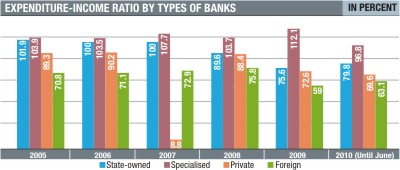
Private banks and foreign commercial banks operating here were more efficient in managing their expenditure than the state-owned commercial and specialised banks, a central bank report shows.
The report found that a Private bank spent 93.1 percent of its income in 2003. Such expenditure was 69.6 percent in June 2010, down by over 25 percent between the periods.
The foreign banks have minimised the costs by 21 percent, state-commercial by 19 percent and specialised banks by only 4 percent between 2003 and 2010, according to the draft annual report of Bangladesh Bank (BB).
The cost-income ratio is a key financial measure, particularly for valuing a bank. It shows a bank's expenditure in relation to its income. It is useful to measure how costs are changing compared to income -- for example, if a bank's interest income is rising but costs are going up at a higher rate, it may not be good for the bank.
The Bangladeshi banks have long been blamed for poor efficiency, which pushed their costs up. It also increases the borrowing costs.
Bankers credited young professionals, use of technology and declining bad loans for a significant fall in costs in the just-concluded decade.
“Young generations are bright and their productivity is higher than their older colleagues,” said Shahjahan Bhuiyan, managing director of United Commercial Bank, who has nearly four decades of experiences in the banking industry.
Bhuiyan also attributed the success to the falling non-performing loans (NPL).
BB data shows that the average NPL for the banking sector was 17.6 percent of their total loans in 2004, which came down to 8.7 percent at the end of June 2010. The private and foreign banks are the best performers in terms of controlling bad loans with only 3.7 percent and 2.4 percent respectively as of June 2010. The NPL was nearly 23 percent for the state banks.
“The banks are heavily investing in technology, which ultimately helps us with efficiency enhancement and managing the costs,” said Anis A Khan, managing director and chief executive officer of Mutual Trust Bank.
According to Khan, the main reason behind the fall in the expenditure-income ratio was a tremendous growth in the banks' profit.
[email protected] Source: The Daily Star/ Bangladesh/ Jan-7-2011
Atiur assures banks of supports, asks transparency first
Bangladesh Bank (BB) Governor Dr Atiur Rahman said the central bank would provide cooperation and support to the commercial banks if they ensured transparency and took step against irregularities in a bid to establish discipline in the banking sector.
“We assure the banks of providing all-out supports and cooperation if they ensure transparency in their activities and take steps against irregu-larities,” BB Governor said at a seminar yesterday.
He also urged the banks to sustain the growth they have achieved in the last year.
Bangladesh Bank organised the seminar on ‘Financial Crises and Regulatory Deficiency’ at its conference hall.
Former governor of the central bank AKN Ahmed presented the keynote paper at the seminar.
AKN Ahmed said the central bank would not only work independently but also maintain a mutual relation with the government to effectively run its business.
Urging the government for lessening dependency on IMF and World Bank, former BB chief suggested the developing countries to brace themselves to handle financial crisis on their own either unilaterally or collectively by making regional groupings between the countries having similar problems.
He also said the central banks of the developing countries should tune their monetary policies to the needs of the country’s overall development policy.
AKN Ahmed, however, said developing countries should give up their dependency syndrome but not their ongoing dialogues with IMF and the World Bank which, for poor countries, remained the principal source of financial aid on soft terms and technical advice in many areas.
No country could hide from globalisation now, he said observing that globilisation induced growth but growth was not globalised.
In his paper, former governor drew an elaborate analysis on financial crises and regulatory deficiency around the world with a background of the problem by citing cases of different countries.
Dr Atiur Rahman said the paper is a gist of knowledge AKN Ahmed acquired throughout his life and it could play a significant role in helping the officials of central bank in handling financial crisis efficiently.
The officers working in deferent units of Bangladesh Bank attended the seminar.
Source: Daily Sun/ Bangladesh/ Jan-7-2011